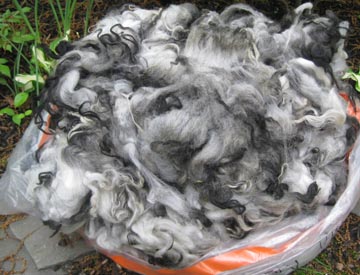
Up and Running …

July 31, 2011

We had exactly the right number of volunteers for the event. John’s daughter, Jenn, and Jessica the Mad Spindler helped out by folding programs in the lessons tent …

Everyone lent a hand to carrying wheels into the tent. Sorry no photos of the tent going up — John and I were the only tent crew, so it was rather difficult to hammer in stakes and snap photos at the same time.

By the time all the wheels were in, John was ready for a break (or, actually, just collapsed amid a sea of Canadian Production Wheels …) …

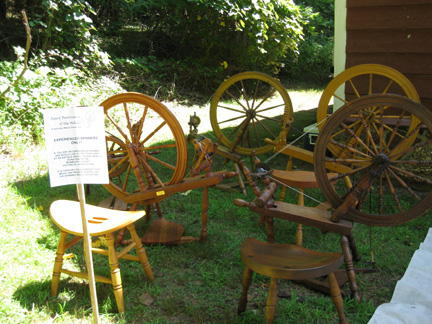
Just behind John is the area set up for experienced spinners to try out a real wheel:

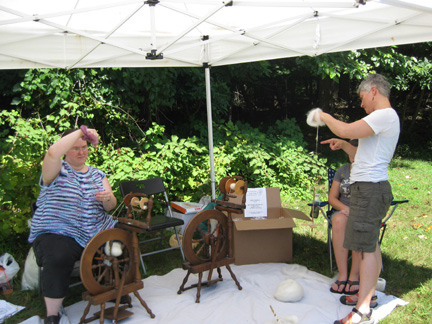
Regrettably, I did not get a good shot of the Timbertops Beaver wheel hiding behind the Reeves 30″ Saxony with right-hand drive, both courtesy of Ravelry’s own pgithens. Pati was in our beginner’s spinners tent, showing her daughter, Taryn, the finer points of drop spindling. See that? It’s called a slub …

Jessica the Mad Spindler spindles away ….

And, yes, I know … where are the wheels?


Setting Up …

July 31, 2011


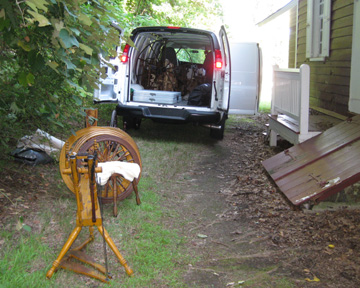
Once arrived, the issue of where to park had to be dealt with. The Holmes-Hendrickson House is very small, and sits on very small plot of land on the top of a steep slope. John did not want to drive the van around the front of the house; he was afraid the van would roll over down the hill. However, there is an about-12 foot strip of cleared land behind the building. Sooooo….

Doggone. Backed it right in. Who knew this guy was such a truck wrangler?

All that was left to do was unload and carry around to the side, where there was the only level spot of ground. Here is the van disgorging its contents …

How steep is the slope in front of the house?  Pretty darned steep …

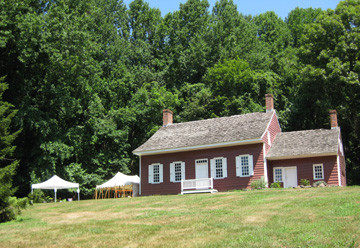
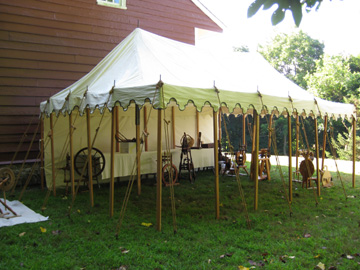
I had to walk all the way down to the brook at the base of the hill to get everything in. The popup tent on the far left is the “learn to spin” tent; the larger one right behind the house is the canvas “big top.”

The house itself has an interesting history. Monmouth County, New Jersey, was settled by the Dutch and the English in Colonial times. This house was built around 1754 by William Holmes, a local gentleman. His daughter married into the Hendrickson family and the house was expanded. The Holmes were English, the Hendricksons Dutch and consequently the house has architectural examples of both cultures, including a large Dutch double door at the front stoop. It is considered English Dutch vernacular style. 

This is not the original location for this structure. Originally, it was built on land that became part of the huge AT&T complex that was nearby. The house was used as a storage shed for many years. In the late 1950s, it was scheduled to be torn down but someone recognized its value and campaigned for it to be saved. The Monmouth County Historical Association stepped forward as willing to become caretakers of the house; the Monmouth County Parks System donated the plot of land which is adjacent to Holmdel Park and the Longstreet Farms historical site. The house was moved to the new site and has been on display ever since. It is a tiny thing and easily overlooked, but is worth a visit as it has a fantastic collection of Colonial furnishings.


Loading Up …

July 31, 2011


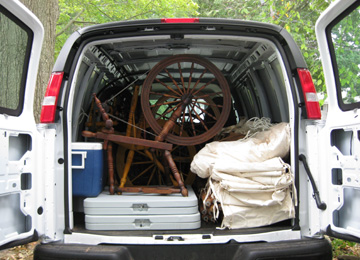
How many spinning wheels fit in an Econoline van? …

That’s a side view. Here is the back …

We would have had room for more wheels if not for the 14’x16′ canvas reenactment tent! Tables and other oddiments did not take up much space.

The really breakable wheels rode with me:


I kept telling everyone that if I carried something and it broke, I couldn’t yell at them for damaging my wheel. Fortunately, I didn’t even have to yell at myself!

Off to the Holmes-Hendrickson House to set up!


CPW Round Up

July 25, 2011


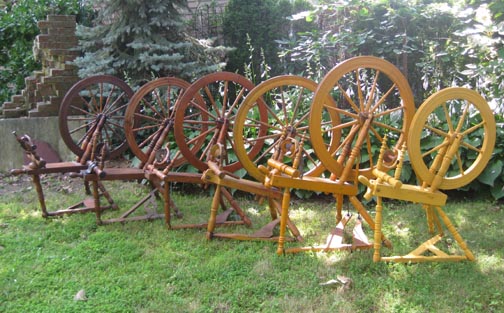
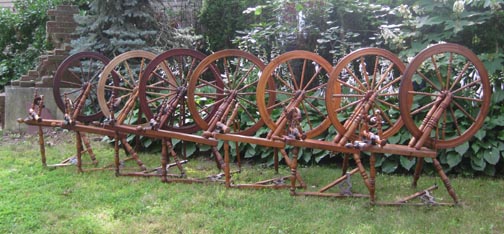
On July 4th, what better way to celebrate than with a parade of Canadian Production Wheels?


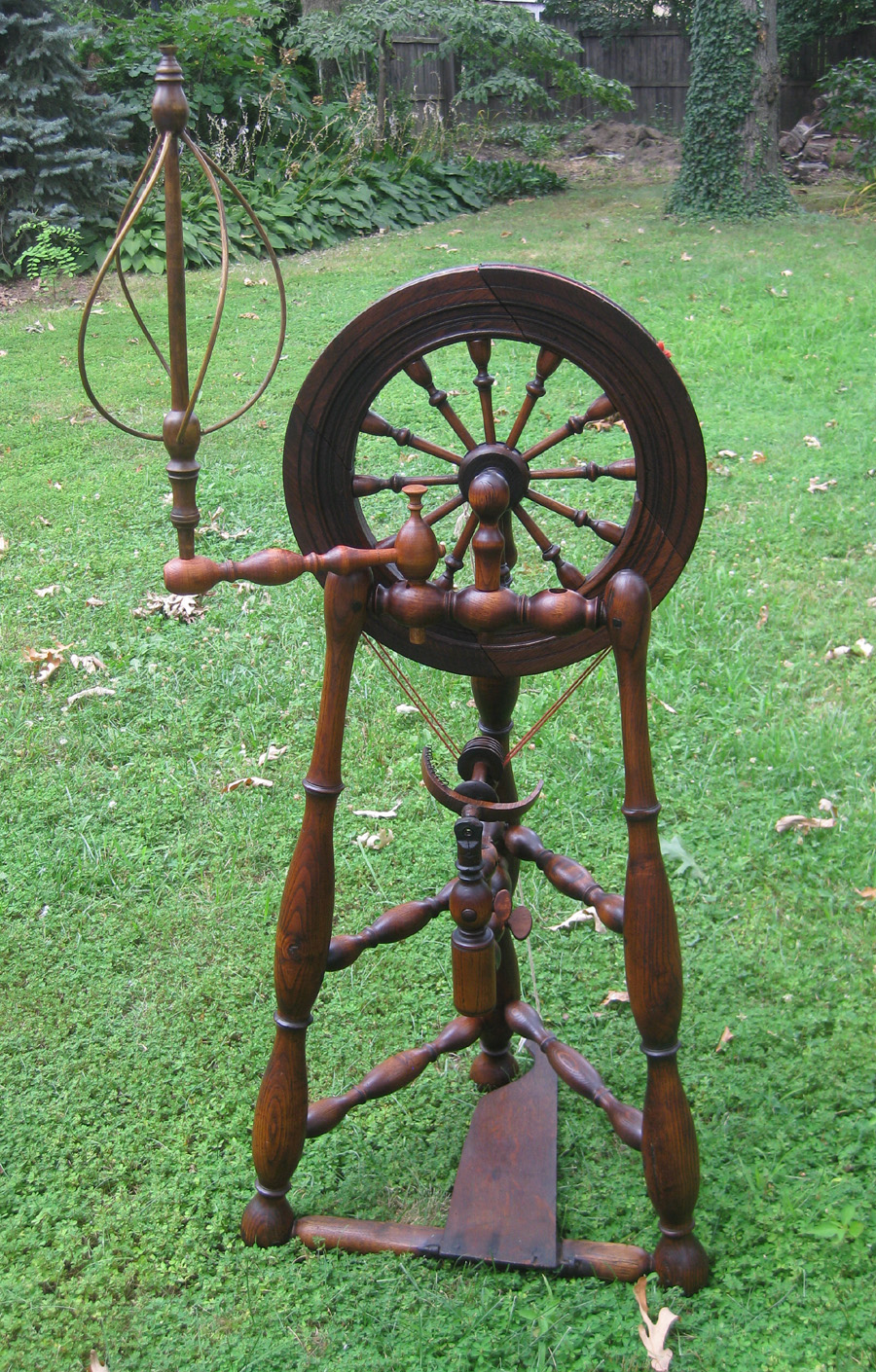
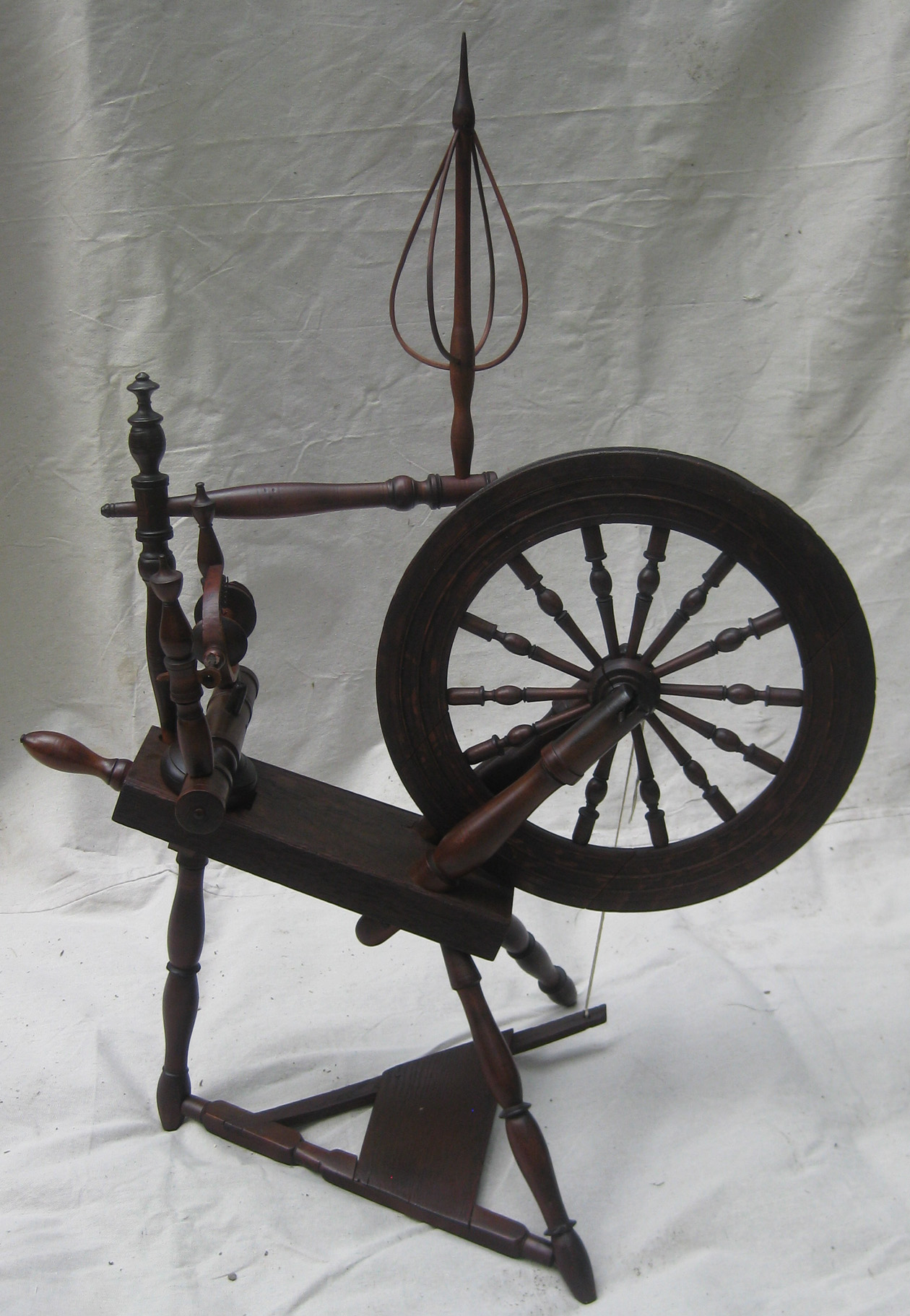
The smaller wheels:


The larger ones:


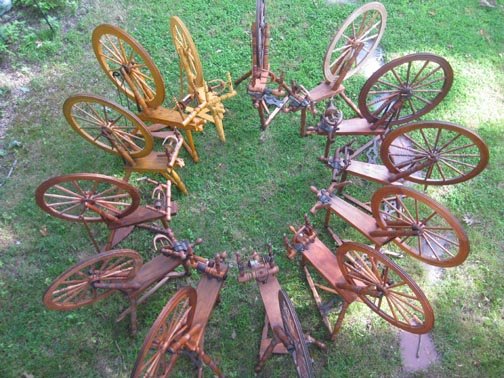
The ladies’ social circle:


And let’s see that from above:

If you haven’t seen enough, visit the walk-through of wheels on YouTube at: http://www.youtube.com/watch?v=eHituSLkrFw

Apologies for any bad camera work and also for the plane flying overhead during the shot! These are banner-towing planes that fly low over the beach. I’m so used to them, I didn’t even realize one flew over while I was shooting until I heard it on the recording afterwards. The things you get used to!


Wheel Cleaning Day

July 25, 2011

I am remiss in my blog posts this summer. I have either been on the road every weekend (usually picking up another wheel) or have been cleaning both the wheels and the house. We are looking to get some renovations done, but in order to do so, need to make some space. In order to make space, things have to be reorganized or, in some cases, disposed of.

One of the biggest space hogs in my garage was the front end of a 1951 Chevrolet pick up truck. I am happy to say that on Sunday morning, after 20 years in my garage, the parts went to their new home in Connecticut where they once again will get a chance to be a truck.

Several wheels are also on their way to new homes, although the CPW destined for Salt Lake City is posing a problem. If anyone is driving out that way and wants to take a wheel along, please make sure to PM me!

The other big push this summer has been to get ready for the antique spinning wheel showcase on July 30. I’ve been cleaning wheels every night after work, but still had several to do. So on Sunday, I set up my cleaning table outside, along with the popup tent, and spent a day washing and oiling wheels.

Here are today’s slate of wheels for cleaning:
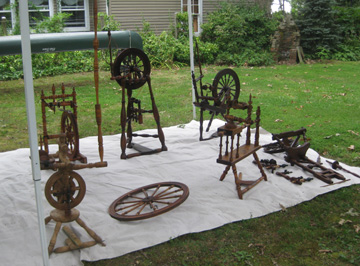
 

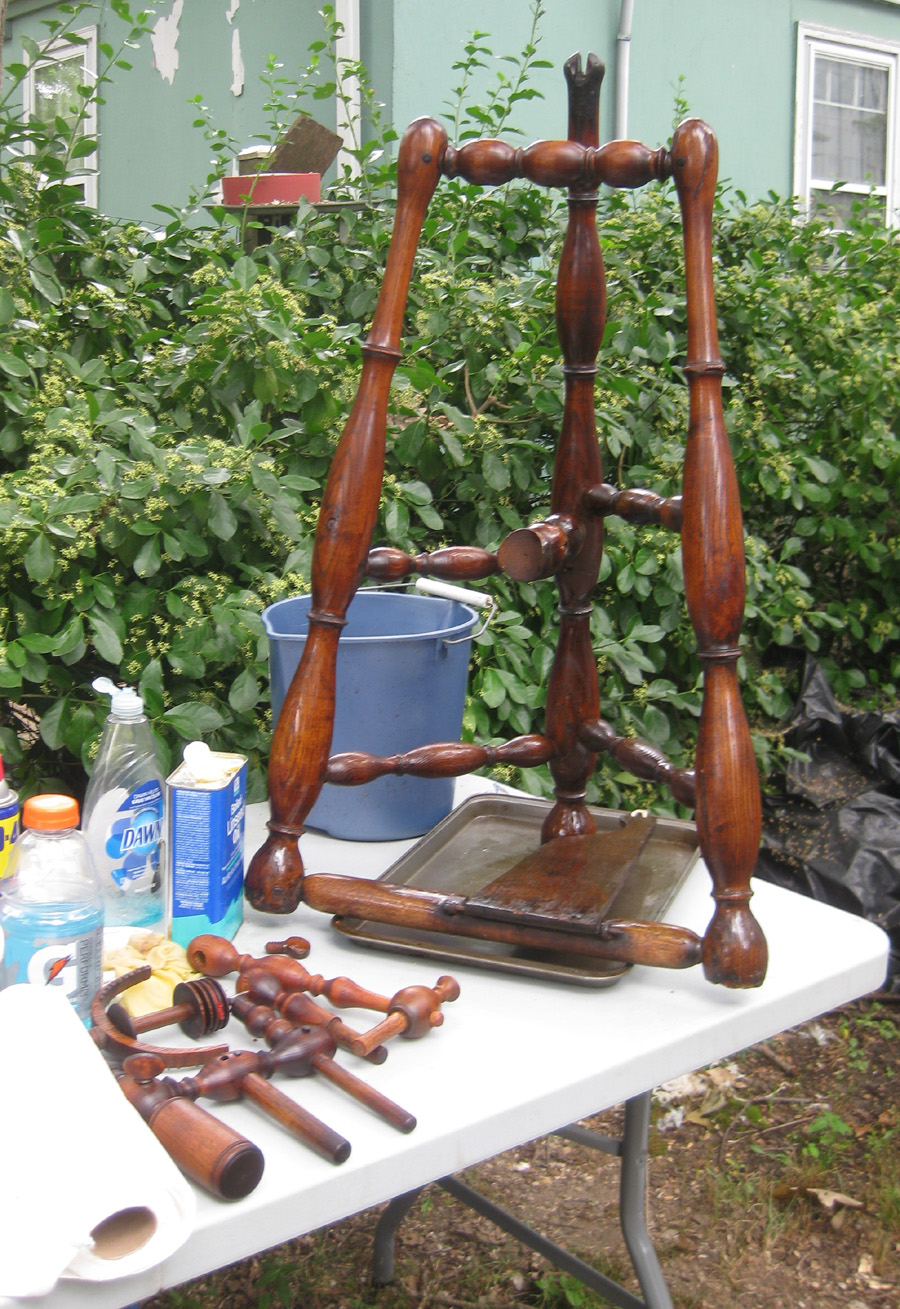
One of the major pieces I wanted to get cleaned was the Irish Castle Wheel. I love this wheel, but rarely use it for spinning. This was more of an antique display wheel. Here it is dismantled for cleaning:


Here is her MOA assembly:
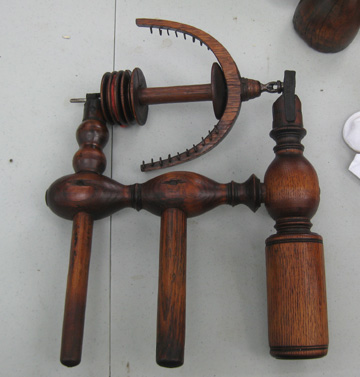


The pegs on the left and in the center fit into a crossbar; the piece on the right fits against the end of the crossbar and is held in with a wooden screw. I’m always nervous about stripping or breaking the screw when tensioning. If it goes, I would need to find a woodworker to turn another one before I could get this spinning again.


Amazing what a little Murphy’s Oil Soap and boiled linseed oil will do!

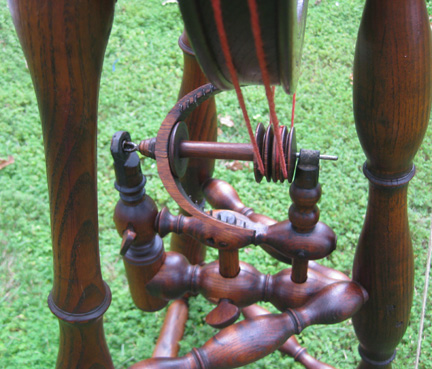
Here is a closeup of the MOA in place, showing the two wooden screws that hold it steady:
 

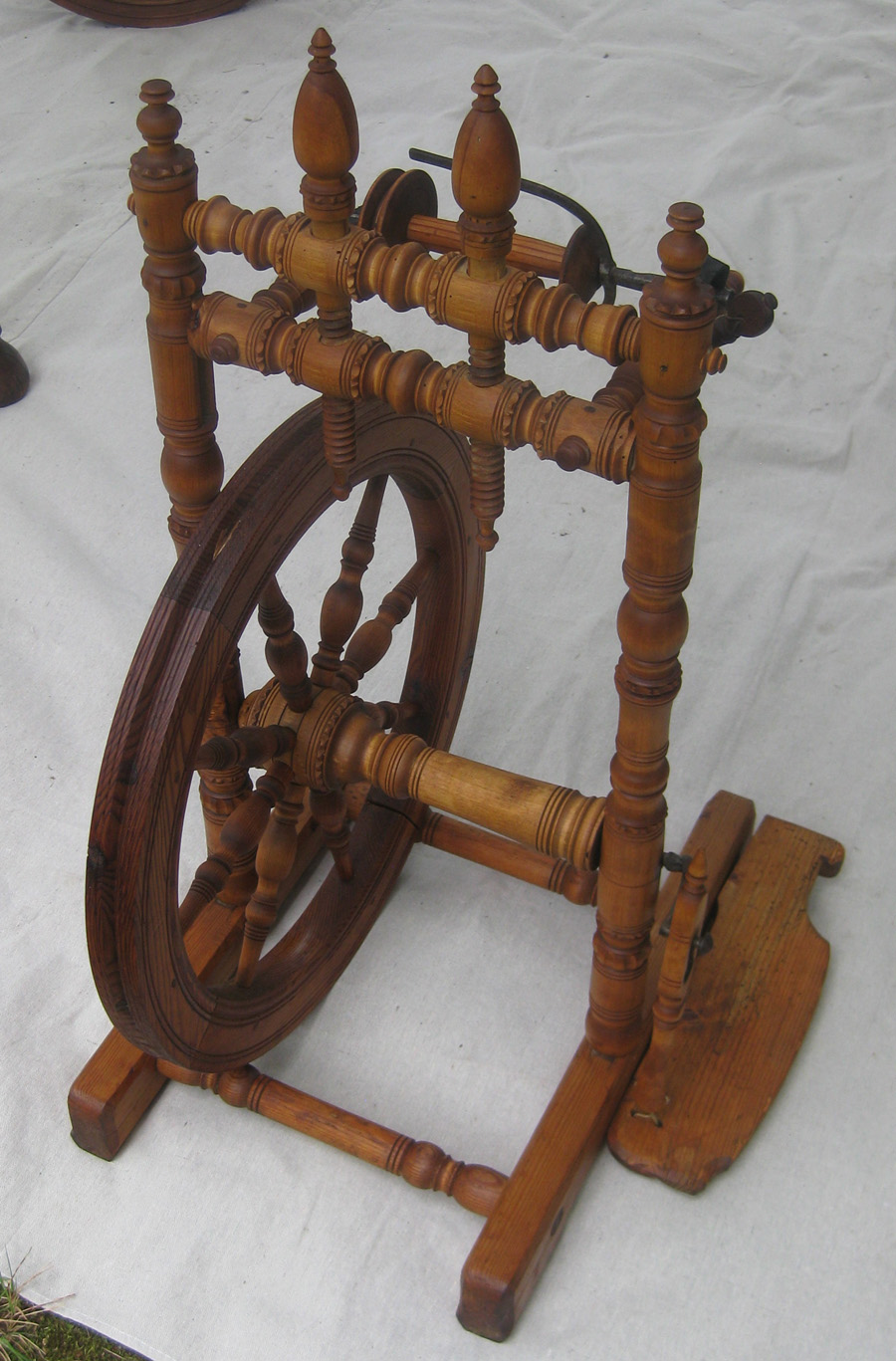
Other wheels that got the spa treatment, were Margarete, the German lateral treadle:


Phoebe, the American Saxony, likewise got a cleaning:
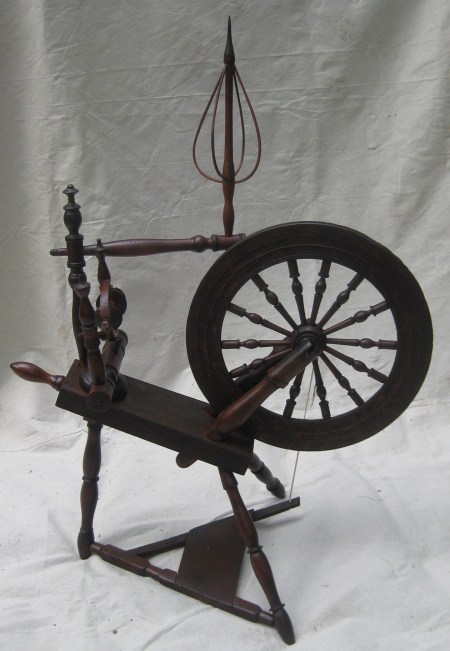
 

The as-yet unnamed Norwegian Bench Wheel after her oiling:
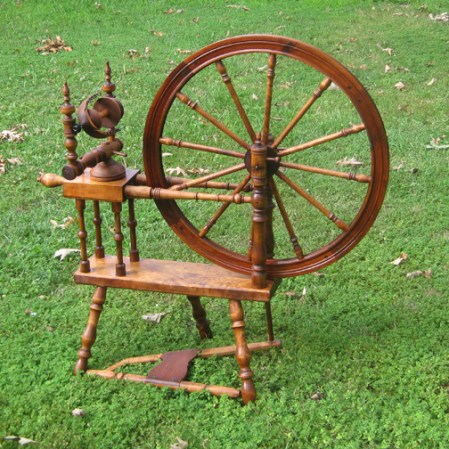
 

“Every Revolution of the Wheel” will be presented at the Holmes-Hendrickson House, 62 Longstreet Road, Holmdel, New Jersey on Saturday, July 30 from 11 AM to 4 PM. In addition to the wheels, non-spinners can learn to spin on drop spindles or on a modern wheel. There will be ongoing demostrations of spinning and fleece preparation. Stop by and say hello if you are in the area!

Every Revolution of the Wheel

July 4, 2011

For anyone who might be in the area, on Saturday, July 30, I will be holding an exhibition of some of my spinning wheels. It will be from 11:00 AM until 4:00 PM at the Holmes-Hendrickson House in Holmdel, New Jersey. This is one of the houses held by the Monmouth County Historical Society. We will have over two dozen wheels in display, demonstrations and lessons in drop spinning and wheel spinning, and lots of other fiber fun. Please come see us!


A Stranger in Paradis …

June 12, 2011

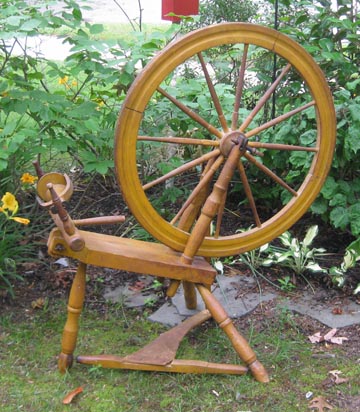
Brought home this wheel yesterday:

We changed our plans from going to the annual Spin-In at the Mannings in Pennsylvania and instead went to St. Michael’s, Maryland, for this yellow beauty. We have an attraction for St. Mike’s to begin with, having been married on the lawn of the Talbot County Courthouse in near-by Easton. We are always looking for an excuse to go down there, so when this wheel showed up in St. Michael’s, it seemed an obvious choice.

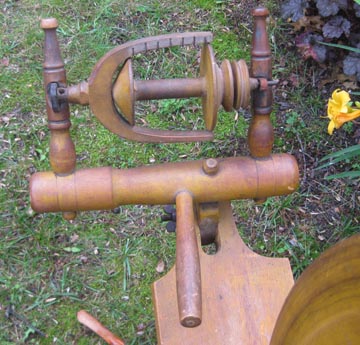
The seller told us she had acquired the wheel, ironically in New Jersey, some 28 years ago but had never spun on it. She did not realize the MOA was installed backwards, so anyone trying to spin on it would have had some trouble! The seller also told us that the dealers who had the wheel said they had gotten it from an estate sale in West Virginia. Beyond that, she did not know anything about the wheel, except that it might be Canadian. In that, she was correct!

With her MOA put back into proper position, you can see her tilt tensionining:

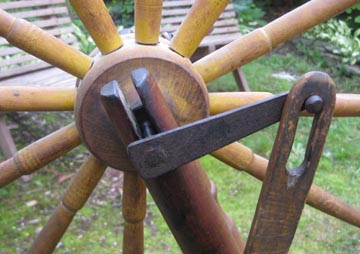
She has one carved pin holding in her wheel axle, and what a big pin!

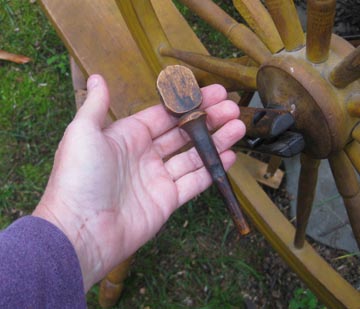
Her wheel crank is straight. I had never seen this shape before two weeks ago, and now here is another one!

She has that lovely swooping treadle. The treadle needs to be renailed to the front crosspiece, but this is an easy fix. I like the amount of wear on the treadle — someone obviously did alot of spinning with this wheel.

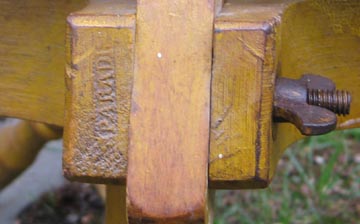
But, perhaps best of all, she has a maker’s mark:

I did not see this until this morning when we unloaded her from the car. She is stamped “Paradis” on the front of her bench, next to the tensioning device. Now, to figure out if that is Aram Paradis, Lucien Paradis, or another member of the family.


Two Wheels are Better Than One!
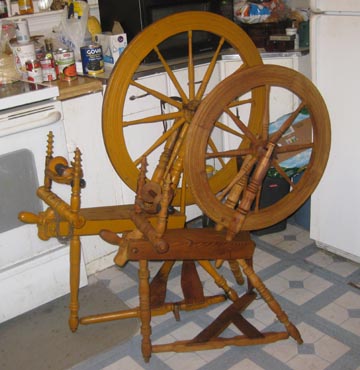
June 6, 2011


This is a completely unexpected topic! A new wheel arrived today from Germany, and she has a feature I’ve never seen on the wheel. Not even on this one, because it was not obvious in her photographs.
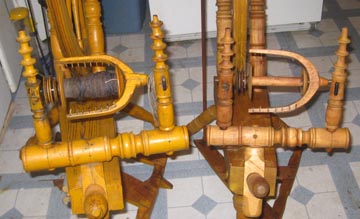
She is a lovely little upright wheel with her distaff:

Her flyer is in good shape. No hooks, but one of those primitive precursors to a Woolee Winder — a piece of wire twisted into an eye hook that can be removed to the next hole:

The flyer has a clever, neatly mended patch on either side.

She is not a terribly fancy wheel, but does have a bit of carving on her tensioning knob:

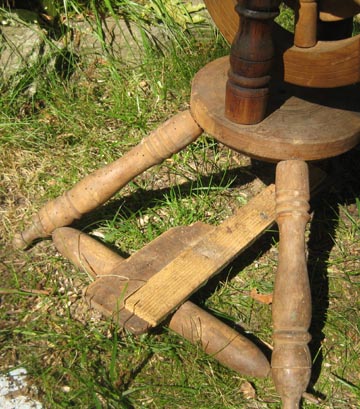
She has seem some use, if her treadle is any indication. It is split clean in two and mended with a slat:


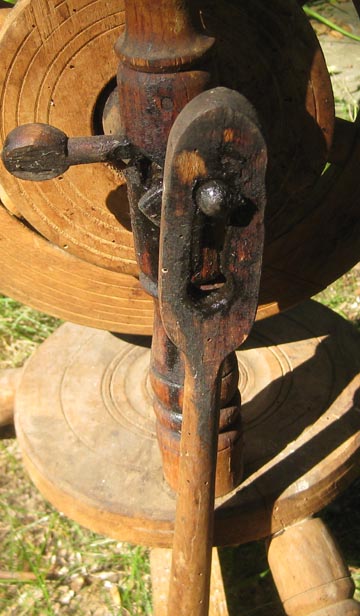
Her footman has a bit of carving and alot of axle grease. My word! Her crank is just dripping with grease:

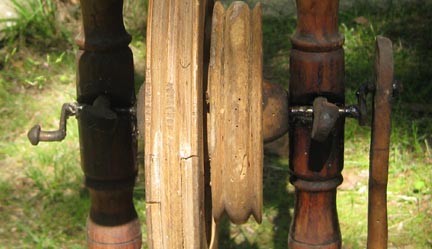
Yes, her axle is just dripping in black grease on both ends. Oh, wait, she’s in backwards. Her crank is sticking out the front. But…wait, if her crank is stick out the front, what is her footman attached to:

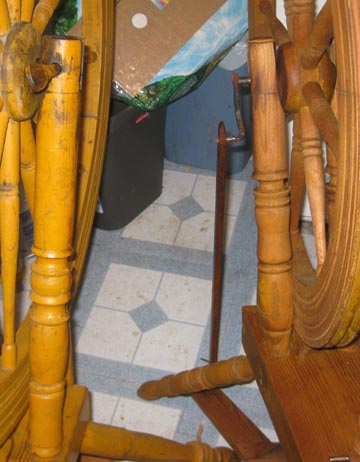
Well, I’ll be doggoned … this one has a reversible double wheel:

If anyone out there is familiar with this set-up, please post a comment and let me know!


Little Wheel, Big Wheel

June 1, 2011

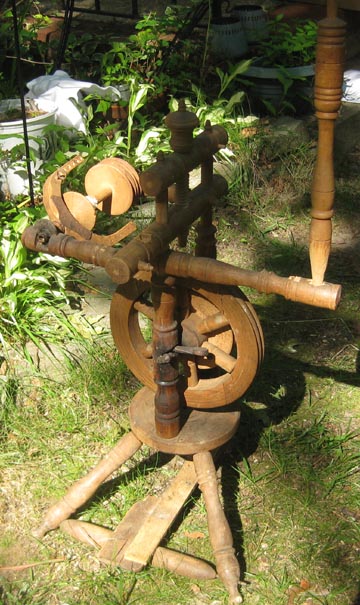
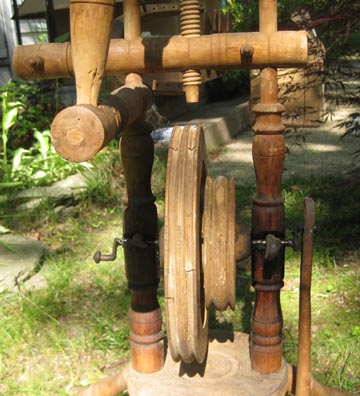
First, we start with the little wheel. I have had the little wheel for several years. She was tucked away in the basement workshop, largely forgotten as I pursued other interests and other wheels. But one day I renewed my interest in the little wheel.

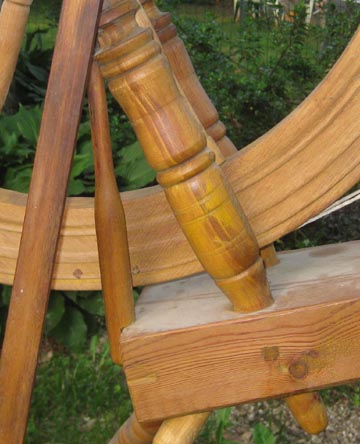
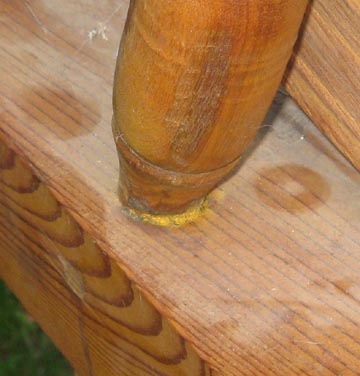
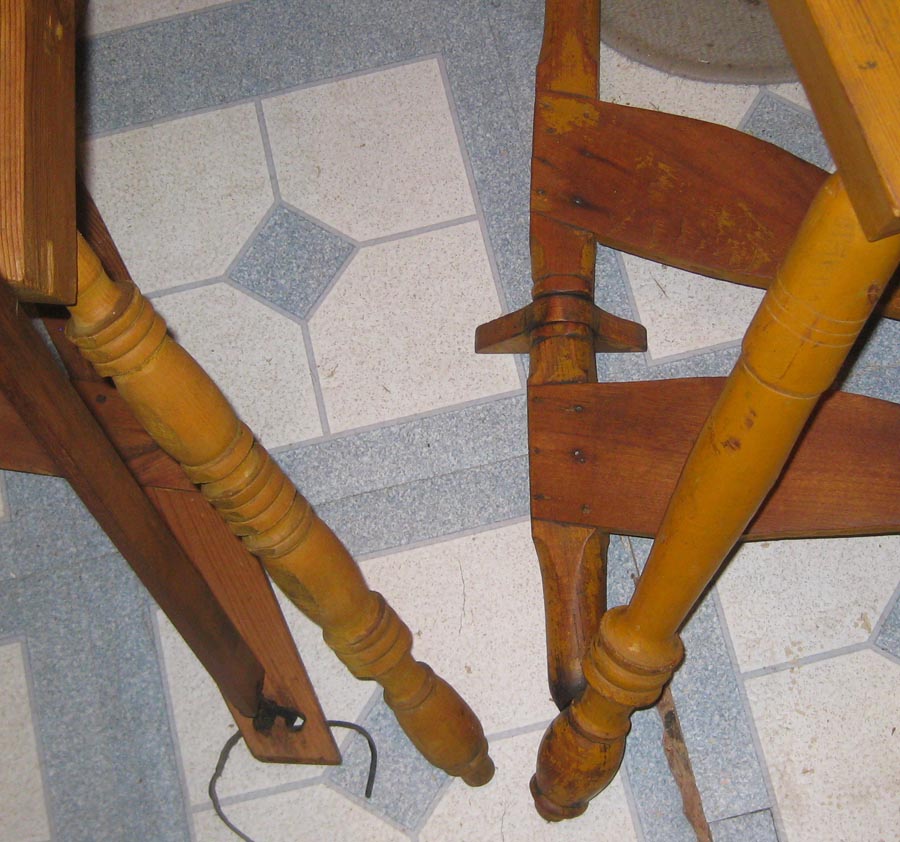
First of all, the little wheel was once painted yellow. That is apparently from her many remaining yellow spots:

One of her uprights:

The base of the other upright:

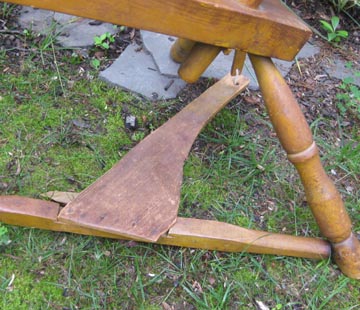
And especially one back leg, which did not seem particularly yellow close up, but obviously was when viewed from a short distance away:

But the thing that really renewed my interest in the little wheel was not her former finish, it was acquiring a big wheel, a big wheel close enough in design to be her mother:

The bigger wheel is a double-treadle Canadian Production Wheel, believed to be by the maker, Ouellet.

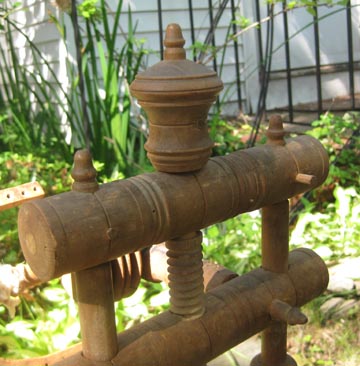
The wheels share the same maidens. Some wheel mavens call these “Jetson” maidens, although personally I think they look like pagodas. The bigger wheel has one extra pagoda level:

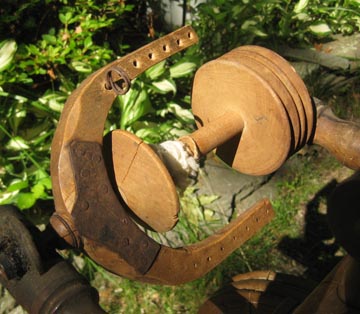
The carvings on the mothers-of-all match. The tilt tensioning is almost identical. Her uprights are similarly carved:

The legs of the smaller wheel are a bit more fancy:

And their spokes:

The benches are similarly shaped, with a tapered front:

Because the smaller wheel has only a 25″ drive wheel, the debate rages as to whether or not she is considered a Canadian Production Wheel or not. She definitely is Canadian and was purchased in Quebec, she shares the same attributes as the larger wheel, and possible shares the same maker. At least, she shares the same patterns on her turnings.

The yellow ochre milk paint is on order and in the coming weeks, she will again return to her earlier glory. Her larger counterpart may get a new coat, as well!


Emsket Fleece

May 22, 2011

Several times in the past, I have raved about the quality of Shetland fleeces from Windswept Shetlands in Michigan. Not only do you get quality fleeces, you also get quality service.

A few weeks ago, I e-mailed Windswept shepherd Mike Ludlam and inquired into an emsket fleece. Mike said they had just sheared and he would keep his eye open as he sorted and skirted. Then about two weeks ago, he e-mailed saying he had two fleeces from the same new ram: the lamb’s fleece and the first adult shearing. He indicated that the color had changed slightly; the first adult shearing was more of the steely blue-gray, but the lamb’s fleece was a bit more dramatic in its coloration.

Of course, I had both shipped out. The first adult shearing is a beautiful fleece, but, because it is a bit more dramatic, here is the lamb’s fleece:

This is another candidate to be spun in the grease. Thanks, Mike!