Seaweed Scarf

June 13, 2013


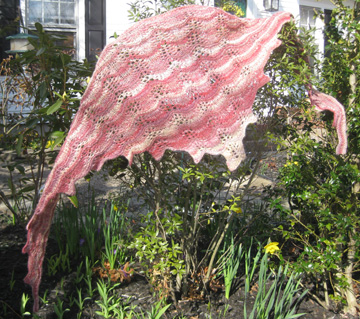
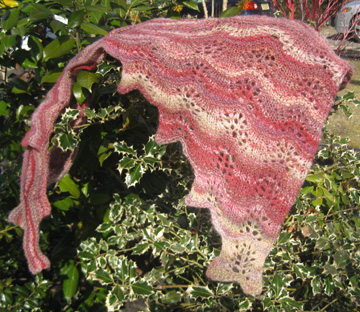
Over the winter, I had knitted up two Seaweed Scarves from designer Grace Akhrem’s pattern by this name. What better place to photograph a Seaweed Scarf than the beach?

scarf 03

We thought they looked a bit more like rays or skates, than seaweed, but nonetheless, this is a lovely, easy pattern that works up quickly and I would highly recommend if you are looking for a shawlette-style scarf. The pattern gives three different sizes of yarn and needles to work with, and it doesn’t require too much yarn (around 300 yards), so it is pretty versatile as to what you can work it up in.

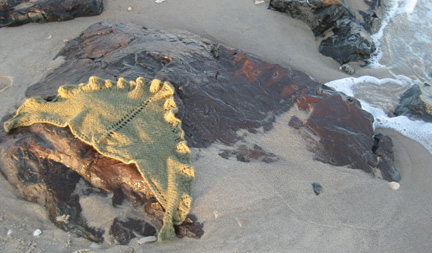
For the green version, I used the sadly discontinued (and out of business) Nashua Yarns Creative Focus in an olive green color. The olive wasn’t really olive; it was shaded with coppers and blues and really is lovely. With its lettuce-edge finish, it really had a seaweedy effect. Or manta ray, we still haven’t decided which:

scarf 02

Yes, I know the photo looks a bit like it was posed in Death Valley, but I assure you, only the Jersey Shore. This is what Hurricane Sandy did to some of the beaches in terms of erosion.

It was quite breezy at the beach when we shot these. We tried to get some arty shots on the rocks with the water, but the breeze threatened to carry off any light-weight knitwear. My husband was under strict orders that if anything blew, he was to immediately go after it, even if it went into the water. He then suggested maybe it wasn’t such a good idea to keep posing things on the rocks near the waves:

scarf 06

Another ray on the rocks!

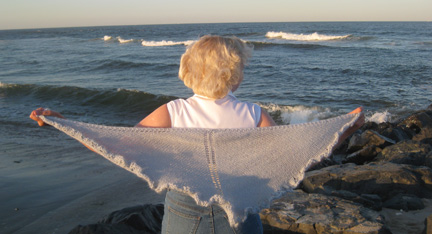
Of course, the breeze was helpful when styling other shots:

scarf 04

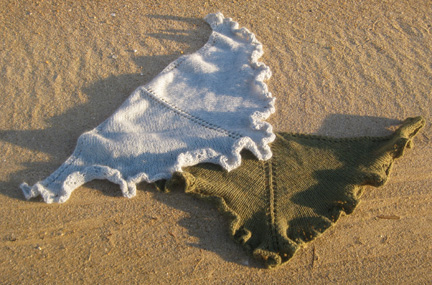
The blue scarf was knitted in Rowan Kid Classic in a pale blue color. I used two skeins and made the scarf slightly larger than the green one. For the green one, I only had the one skein and was afraid it wouldn’t be enough so I skimped on the cast off which requires a picot edge. It turned out that the edge was curly enough to hide this omission. I did add the picot cast off to the blue scarf but it was a little like gilding the lily …. you really don’t see it that much with the other curls.

scarf 05

Searching the horizons for my next project ….

I would highly recommend this pattern for anyone looking for this style scarf. You need a couple of stitch markers to make sure you keep the back seam and increases straight. I think I used a size 9 or 10 needle, so it works up fast. Add a couple of extra rows for a shawlette rather than a scarf. Wear and enjoy!

scarf 01


Handspun

June 11, 2013


Handspun ….

english garden roving spun

Because:

1.) Sometimes, you just have to put at least one of those spinning wheels to work!

2.) Being treated for Lyme Disease stinks but the symptoms abated enough that spinning felt good.

3.) All that roving from Maryland Sheep and Wool is sitting here, waiting to be spun.

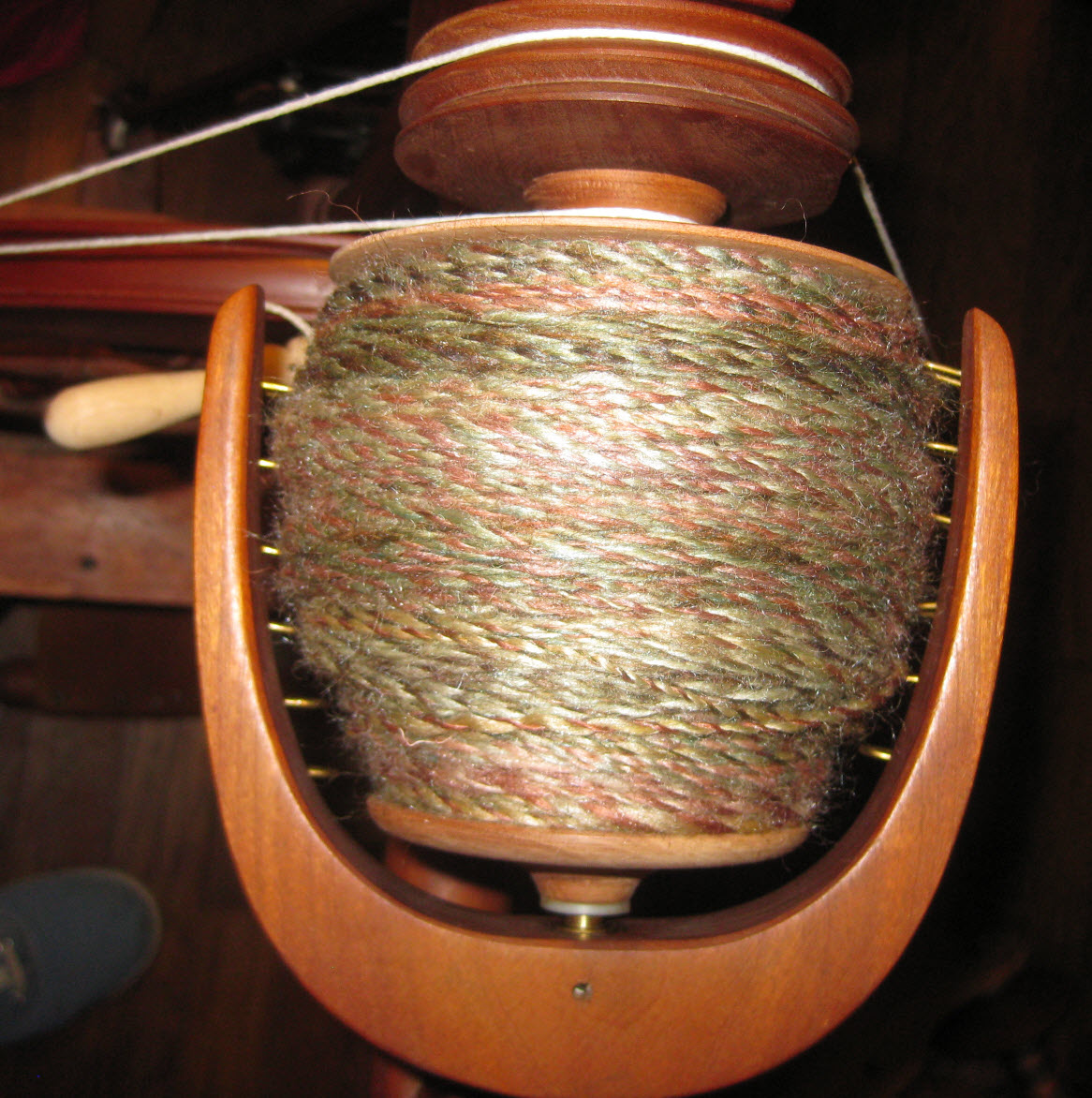
This is called “English Garden” and is a blend of bluefaced leicester and silk, which is why it was hard to get a good photo — the shine of the silk kept reflecting. Double-ply, not sure the yardage yet.

I felt like I was being productive again.


Wisteria Arbor Shawl Redux

June 10, 2013

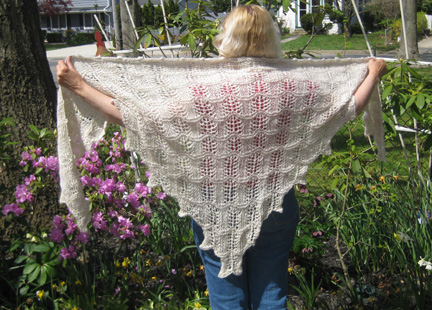
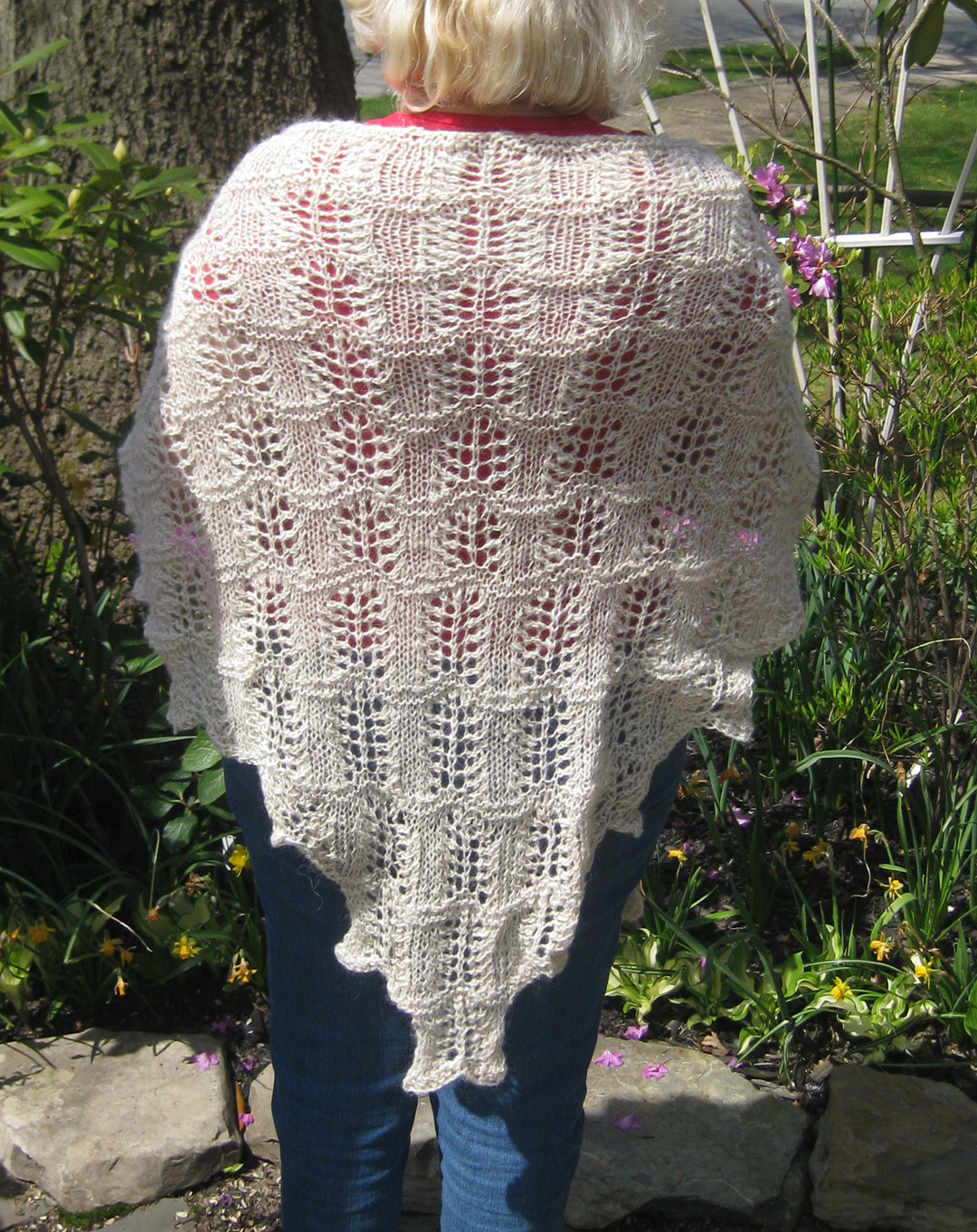
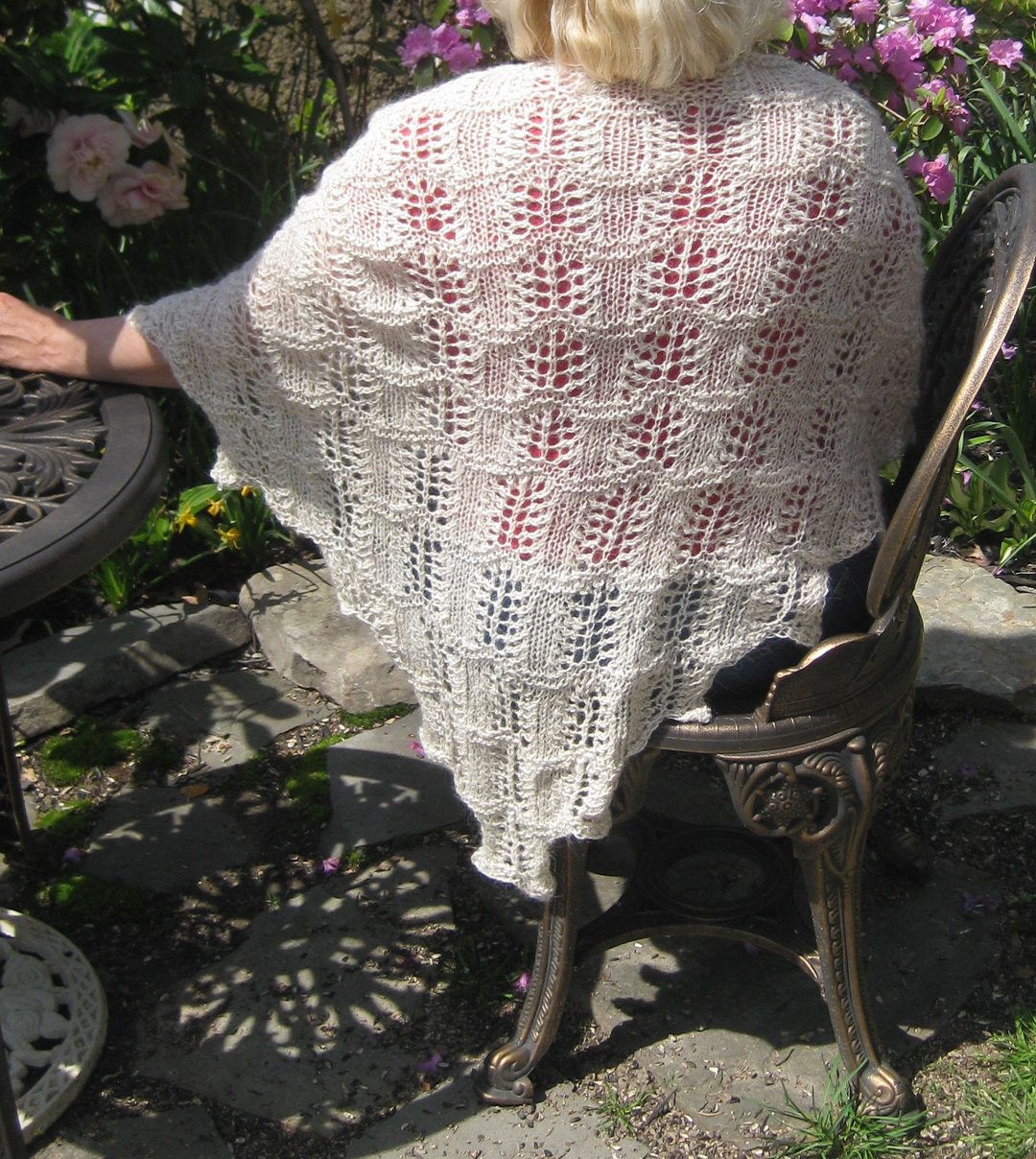
I never did a lot of lace knitting, but I’m liking this Wisteria Arbor Shawl pattern more and more! It is easy to memorize and works up pretty quickly. This is one I recently knitted as a retirement gift. It is worked in my own handspun, a blend I had made up of Shetland wool, silk, and angora bunny.

shawl 02

You start at the bottom most point and work the first level. Then you cast on for the beginning and end of each subsequent level.

05 shawl

I used a picot cast-off which is not in the pattern but I like the nobbly finish it gave the upper edge but you don’t really see it in the photos. What you do get is the effect of color behind the knitting!

01 shawl

I wish that the texture of the yarn showed up better in the photos, too. I was very happy with the way the yarn turned out. Knitted up, it had that slight halo of angora. And you can see the picot cast off a bit in this photo:

04 shawl

For all the lacework, the shawl is warm! Remember that silk is 40% warmer than wool, so combining wool, silk, and bunny fur makes for a very warm piece to wrap up in.

03 shawl

At some point I may get bored with this pattern or decide to pursue something more complex, but for the moment I am still experimenting to see how it looks in different yarns and fibers.

06 shawl


March Garden Update

April 24, 2013


I am a bit behind on my posts. In preparing to do an April garden update, I realized I missed March!

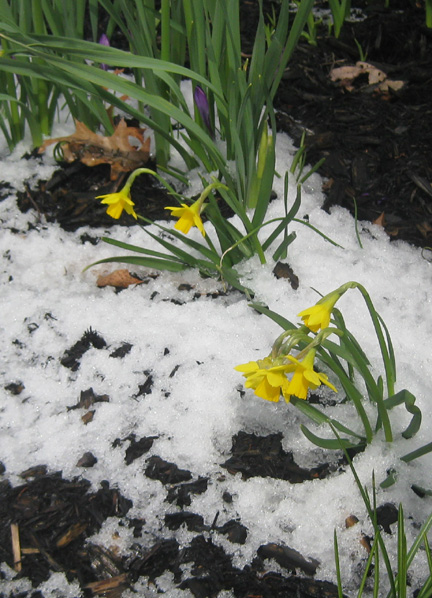
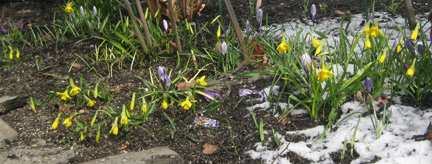
March came in like a lamb that hung around for about a day, then immediately turned lion-like. We had several strange snow events, where it snowed for 12 and 15 hours but accumulated next to nothing. As it snowed, the daffodils began to appear.

march 001

march 002

The witch hazels kept on blooming, right through until almost the end of March. We had almost two full months of blooms from this!

march 003

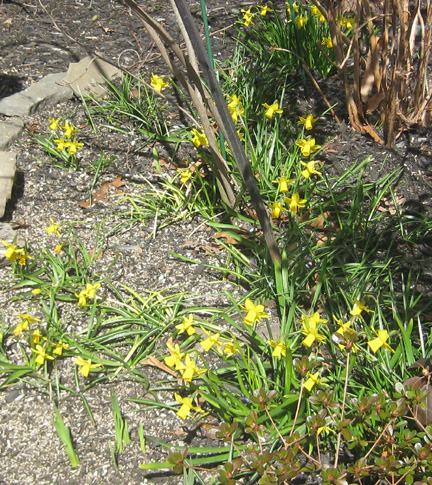
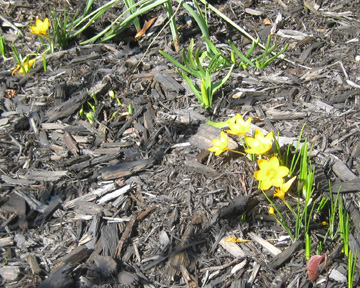
And the daffodils began to appear in force:

march 004

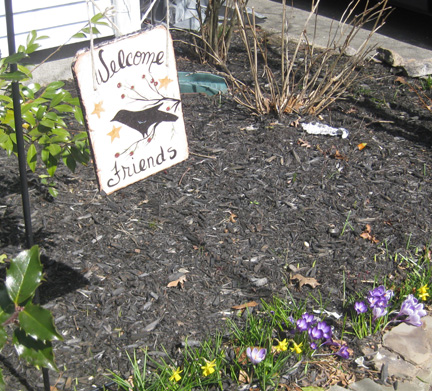
Sometimes they were mixed in with the crocus:

march 005

In some places, there were more crocus than daffodils:

march 006

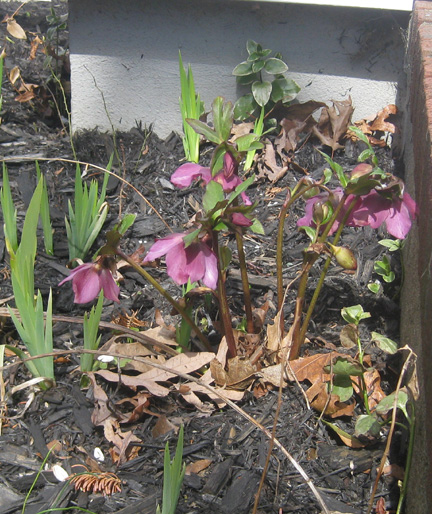
The hellabore by the front step began to open up:

march 007

By the end of the month, more daffodils, a foreshadowing of what was coming:

march 008

We varied all that yellow with some pansies:

march 009

And hiding in the back near the new raised rock wall was this demure clump of crocus:

march 010

By the beginning of April, the bulbs had completely taken over the gardens! We had a bumper crop this year, but that will wait until April’s garden update!


Spring Daffodils

April 24, 2013

“I wandered lonely as a cloud

That floats on high o’er vales and hills,

When all at once I saw a crowd,

A host, of golden daffodils;”

daffodil 10

We had a  bumper crop of daffodils this year. At one point, the front garden was a perfect Disneyland of Daffodils and I sent e-mail messages to local friends, telling them to stop at the house and see the blooms before they vanished. The ones in the photo here are the little Tete-a-tete minis, which I love.

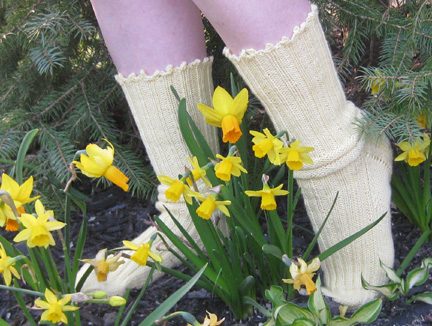
And in honor of the daffodils, what could be better than Daffodil Socks?

daffodil 09

These were based on a pair of baby socks I found featured on the Web. I e-mailed the designer to see if it was okay to link to her post, but did not get an answer. However, they turn up readily enough if you google “daffodil socks.”

I made some substantial changes to the original, other than the size. After casting on 60 stitches with a picot cast on, I knitted the leg in a knit two, purl one rib to give it more definition. I made the purl rolls at the ankle 4 rows, three of all knit, and then 5 purl rows. I think I would do these slightly broader next time, as they did not roll quite large enough. I also did the heel flap and the top of the foot in knit 2, purl 1 because I like a snug fitting sock.

daffodil 03

They suited the day perfectly.

daffodil 05

I love the picot cast on. I have now starting using this quite a bit, for both cast on and cast off.

daffodil 01

The yarn is Sirdar’s Sublime Baby Cashmere Merino Silk in “Litte Chick.” Two balls; there is 184 yards per ball.

daffodil 08

“For oft, when on my couch I lie

In vacant or in pensive mood,

They flash upon that inward eye

Which is the bliss of solitude;

And then my heart with pleasure fills,

And dances with the daffodils.”


Wisterial Arbor Shawl

April 1, 2013


I am, admittedly, somewhat an indifferent knitter. I don’t do swatches. I go through spurts of what interests me. I admired lace knitting but never thought I would try it. Needles too small, too fiddly. Learning disability, can’t read charts and a narrative pattern was too complicated to follow.

Then I knit the little Forester cap discussed in an earlier post. It was an easy chart to follow and I was pleased with the results, so I was emboldened to embark on something a step up. After sorting through patterns that made my head whirl with their apparent complexity, I found the Wisteria Arbor Shawl in the “Sock Yarn One-Skein Wonders” book. The fact that it used U.S. #9 needles was a huge plus!

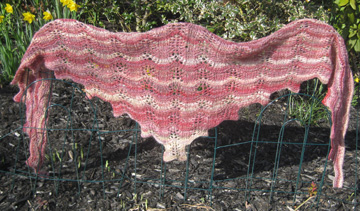
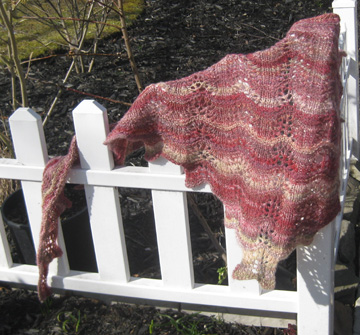
I had a skein of my own hand-dyed, handspun Romney set aside, waiting for the perfect pattern to come along and so launched into the world of lace knitting on a grander scale than the Forester cap. I must say that I am most happy with the results, given the occasional dropped stitch or other error:

WISTERIA SHAWL 01

This is an easy enough pattern, based on the Foaming Waves lace stitch. Four rows of knit stitch, then 8 more total — 4 of the pattern and 4 purl rows. Every 13th and 14th row, you cast on another 13 stitches and keep growing every level.

WISTERIA SHAWL 02

It came out a bit longer than taller and, as I’m short, makes the ends a bit flappy. I plan to make this pattern again and might add a couple of rows to each level to make it a bit longer. Or get to a certain length and just go up from there and not add the additional length.

WISTERIA SHAWL 03

In any event, I was pleased with the results, given my lack of experience with lace. I was pleased with the way the striping of the yarn turned out, as well!

WISTERIA SHAWL 04


February Garden Update

March 12, 2013


February has come and gone, but with it came a hint of spring. Actually, February IS spring. In the middle ages, before printed calendars, people told time by the seasons and lunar cycles. What we call the first day of a season is actually the high point, the middle. When the “start” of summer falls on June 21, why then would you have the old English holiday of Midsummer’s Night on June 24? Maybe because June 24 IS Midsummer?

Consequently, we celebrate the beginning of spring with the coming of the groundhog and the beginnings of the bulbs to poke their noses up through the frozen mulch:

witchhazel 11

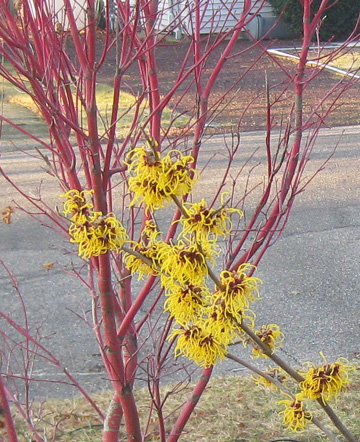
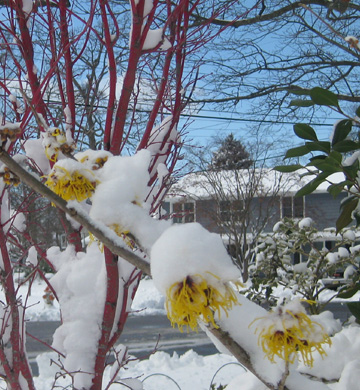
The biggest splash this year, however, definitely was the Barmstedt’s Gold Witch Hazel which began blooming in mid-January. It performed admirably, and as desired, next to the sango kaku maple with its coral red bark:

witchhazel 01

It could be a little taller, but it will get there! It also looked quite handsome with an evergreen camellia behind it:

witchhazel 02

So successful was the performance of the witch hazel that we determined more were in order, to brighten up the gray February days. So, off we went to the Hamamelis Festival. What is a hamamelis, you ask? Why, it is the Latin genus name for the witch hazel and every February these lovely flowers are celebrated the Rare Find Nursery in Jackson, New Jersey. There, the witch hazels were in full bloom and we were able to expand the collection. First, another yellow: the lovely “Pallida” which was said to be the favorite variety in Europe:

witchhazel 03

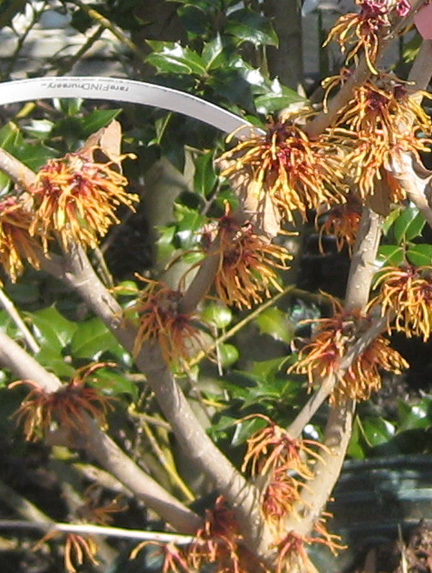
A bold, bronzy-orange variety, “Cyrille”:

witchhazel 04

The coppery-orange “Jelena,” the color I originally wanted and for which you need to read the January Garden Update for the story. This is the real “Jelena”:

witchhazel 05

The not-quite copper, not-quite yellow “Vesna”:

witchhazel 06

And the luminous yellow “Sunrise”:

witchhazel 07


This has tiny flowers that, in the sun, are a pale yellow. On a gray, cloudy day, however, they positively glow luminous yellow.

Along with the witch hazels, we also came back with this pretty, a Mount Aso pussy willow:

witchhazel 08

This picture proves you CAN have color in your garden in February!

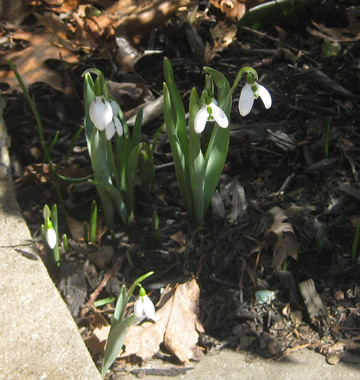
In addition to the witch hazels and the pussy willow, the reliable bulbs began putting in their appearances. The snowdrop that lives by the front step:

witchhazel 10

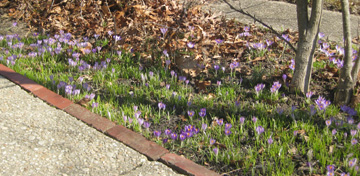
Some crocus:

witchhazel 13

Not nearly as impressive as our neighbor’s crocus, however:

witchhazel 12

And, of course, into every February, some snow must fall. This was after an 8-incher that we had:

witchhazel 15

The Barmstedt’s Gold proved remarkably resilient, however, and bounced back with not a care:

witchhazel 09

Well into March, the witch hazels are still blooming! They will appear again in the March Garden Update.


3 Really Bad Examples of Antique Spinning Wheels

February 23, 2013


A comment to my earlier post on pricing an antique spinning wheel asked for photos. I considered how best to achieve this. I could have taken one of my wheels and removed various parts, then speculated on what a wheel like that would be worth. But then I realized it would be better to take pictures of actual wheels up for sale and point out why they may not be worth the asking price.

This proved to be a much better way to go, and the number of both Ebay and Craigslist postings for spinning wheels provided ample fodder. The hardest part was picking out which examples to use.

First up is this sad case from the Midwest:broken minneapolis
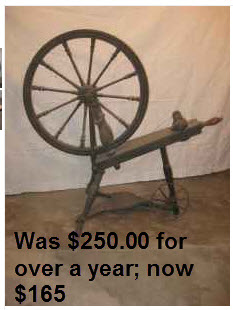
First of all, the photo is terrible. Understanding that many people have limited photo skills and even limited photo equipment, relying largely on what they can do with a cell phone. This listing on Craigslist included a few close-ups which only showed that the finish on this wheel is completely shot — what would best be referred to as “barn-fresh” condition. But the most glaring flaw is that the poor thing is missing it flyer, bobbin, whorl, and maidens. Even with a pristine finish, this wheel will cost between $250 and $300 to have replacement parts made. Throw in another $50 to $100 to refinish and you are talking upwards of $400 on top of a hefty asking price. With that, you enter the range where you may as well buy a brand new Kromski wheel, because this is never going to be worth the investment.

By the way, the asking price of this wheel was $250 for at least a year, maybe two. Spinners in my antique spinning wheel group began discussing ways of putting this poor creature out of its misery. Finally, one of them contacted the seller and as kindly as possible, suggested that with the missing parts, the wheel really wasn’t worth anything. The seller reacted by lowering the price from $250 to $165. At very best, a seller might expect to get $50 if the drive wheel is in good shape. Meaning, no cracks on the hub, the axle is firmly in place and the spokes are all correctly set and not wiggling around. And that the wheel is not warped and turns true. It is hard to tel from the photo, but this appears to be of Scandinavian descent, or American-Scandinavian build, and probably was a fine spinner in her day. Age and neglect have taken their toll however, and even at $50, it would take a lot of work to bring this one back into spinning condition.

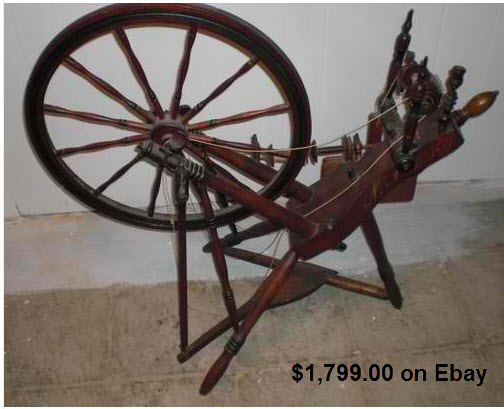
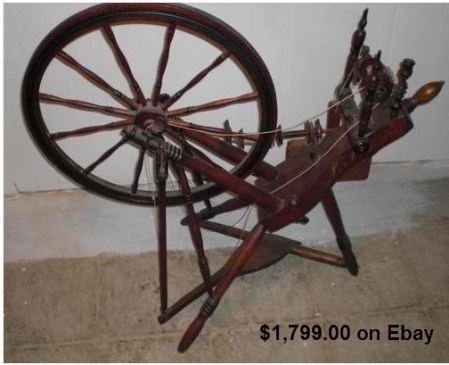
The next wheel is another seller’s pipe-dream. A style typical of Sweden or of Swedish-American make, these little wheels are called “slantys” by the antique spinning wheel people:
overpriced slanty

As lovely as this wheel is, there is absolutely no way on God’s green earth that this wheel (or practically any other) is worth this kind of money. $1,799.00 on Ebay will take it away! She does have her flyer, bobbin, and whorl intact, and also has the benefit of three additional bobbins possible on an on-board kate (or maybe just strung together, hard to tell). She also has a pair of wool cards included. However, she is missing her distaff which is the bit at the end of the bench sticking straight up. She may also be missing a back leg support that typically would run parallel to the floor and brace the two back legs. She not nearly as ornate as some of the little slantys can be. These typically turn up in the Minnesota area and northern region of the county.

Typically, they are priced around $75 to $225 depending on their condition and level of ornateness. This wheel would probably sell at around $150. One can only speculate on why the seller thinks the wheel is worth what is being asked for it. Possibly they feel they have a valuable “anteek” and want their money’s worth. Maybe after it has been listed for a year or more they will start to realize how obscenely over-priced it is. Unless they meant to list it at $179 and then it would be closer to reality.

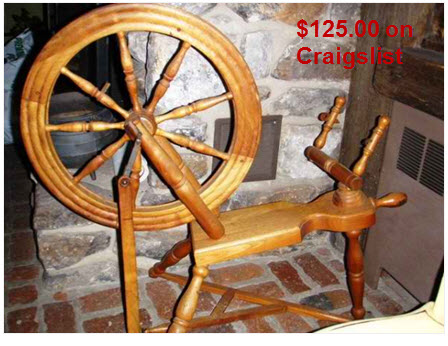
And the third example I put up primarily as an educational moment for both the would-be spinner looking for an antique wheel and for the seller of one of these misbegotten creatures:
SWSO

This is not a spinning wheel. I repeat: this is NOT a spinning wheel. This is the rather ubiquitous “spinning wheel shaped object” or SWSO that takes newbies unawares. I would be willing to place a very large wager that if you turned this wheel over, the underside of the bench would be stamped with “Made in Canada.” Note the fiddle-shaped bench and the 9-spoke wheel. It matters not that the flyer is missing — it wouldn’t work anyway. The flyer, bobbin and whorl on these things is all one piece, and the wooden flyer shaft has no orifice to spin through. Additionally, the tensioning screw … well … isn’t. There is just the knob on the end of the bench and the knob is stationary. Even if you were to put a working flyer on this thing, you couldn’t get the wheel to spin because you can’t tension it.

These SWSOs were made in Canada, probably during the late 50s or early 60s, as a purely decorative item. They are the bane of antique spinning wheel collectors. I suppose the dealers who stumble across them don’t know the difference, assume they work, and try to sell them as real wheels. This example is worth no where near the current asking price of $125. It probably isn’t even worth $25, although a woodworking spinner associate of mine says she buys them for cheap to get them off the market and then repurposes the bench into wooden handles. Apparently, they are made of a very high-grade maple.

Here you have three examples of very bad antique spinning wheel deals — missing parts, finish is destroyed, hideously overpriced, and not even a spinning wheel. If you are a handspinner, or a wanna-be spinner, and you want an antique wheel, that is a wonderful goal, but do your best to educate yourself. If you are someone looking to sell a wheel, don’t automatically assume it is the only one of its kind. Nothing is no unique you won’t find another one out there. Do your homework and price the piece fairly and it will sell. Life is too short and there are too many good wheels out there to either buy or attempt to sell a lousy one.


Snowy Day Projects

February 10, 2013


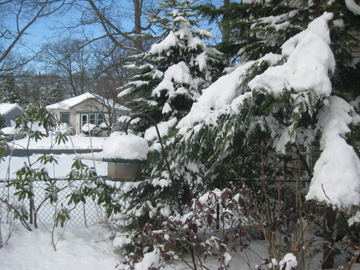
We had snow. LOTS of it. Not as much as the folks in Connecticut or Massachusetts, but far more than we typically get here in the winter. See the bird feeder with its snowy cap on?:

snow garden

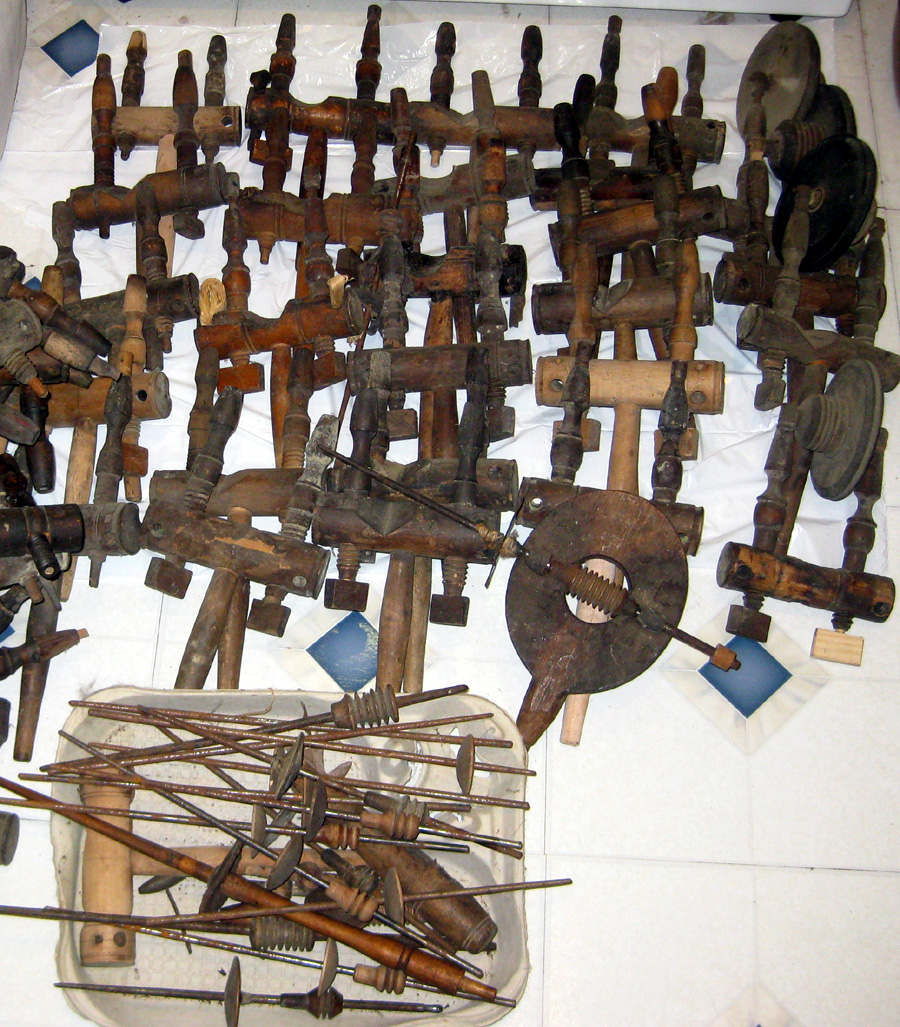
I had made a promise that if I was snowed in this winter, I would start restoring the assorted walking wheel parts I had won at auction over the summer. Here are the Miner’s Heads all ready for their bath:

miners heads 1

And here are the MOAs:

miners heads 2

It was alot. I didn’t get QUITE as far as I wanted, but did get all those miner’s heads through a bath of Murphy’s Oil Soap.

I had my own great wheel in for some judicious cleaning and oiling for an upcoming event. She needed new bearings and, since I had a whole bucket of corn husks soaked, I spent some time making extra pairs of bearings for my renovations, too:

miners head restoration

I also cleaned up and oiled the miner’s head and MOA for MY wheel. Note the walnut oil. This is fabulous for oiling wheels to which you do not want to add any color. Walnut oil is a clear oil and has the added property of swelling shut hairline cracks. I am happy with the final results:

miners head

Tom-Tom is happy with them, too:

tom tom

AND I got time to spin a little:

blizzard spinning

This was some nice Blue-Faced Leicester I’d gotten at Rhinebeck. It ranges from a deep purple, almost black, to a bronzy-brown like the color of a brown fig. I love it and it spins like silk.
All told, it was a productive weekend!


More about Flyers

February 8, 2013


Are you getting tired of flyer stories yet? I keep harping on them because I can’t emphasize enough the importance of them. This past weekend, I was in an antique mall in Pennsylvania where they had a Danecraft wheel for sale. Danecraft was a furniture company that make reproduction Saxony-style wheels back in the 1970s when the Bicentennial was approaching and everyone was nostalgic for the Colonial era. For all the research that supposedly went into these wheels, there were some design flaws. I have one that is an excellent spinner but some folks find them too easily broken. The one in PA was beyond broken — it was missing not just the flyer but the whole Mother-of-All and tensioning screw. Even with that level of disability, the antique store was asking $495. And this for a wheel that in prime condition is worth $100, if it spins. The mind, it boggles ….
Today’s specimen did not cost $495. It did not even cost $100, and that is good because it had the wrong drive wheel on it. Fortunately I had at home a similarly mismatched wheel and once I had the two together, was able to swap drive wheels and get two correctly matched wheels.

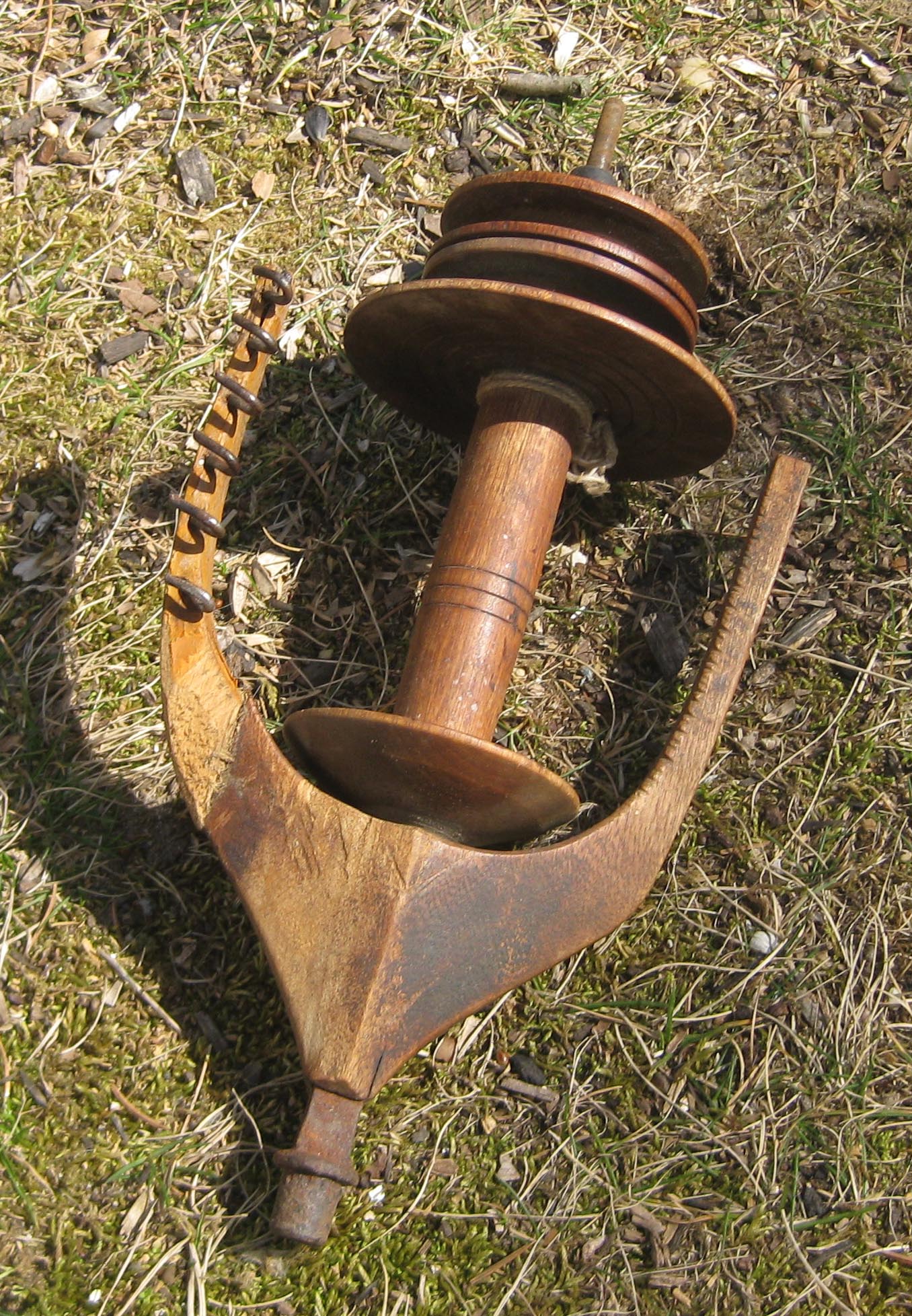
The flyer, however, was a problem. Of course. I seem to find the most craptastic flyers of all times. Here’s what we had this time:


bisson mended flyer 01

Note the distinctive spine down the center of the flyer. This was the style of a family of wheel makers named Bisson. In this case, the wheel is marked Jos. Bisson. Note the left arm of the flyer — see the seam where the wood changes color?

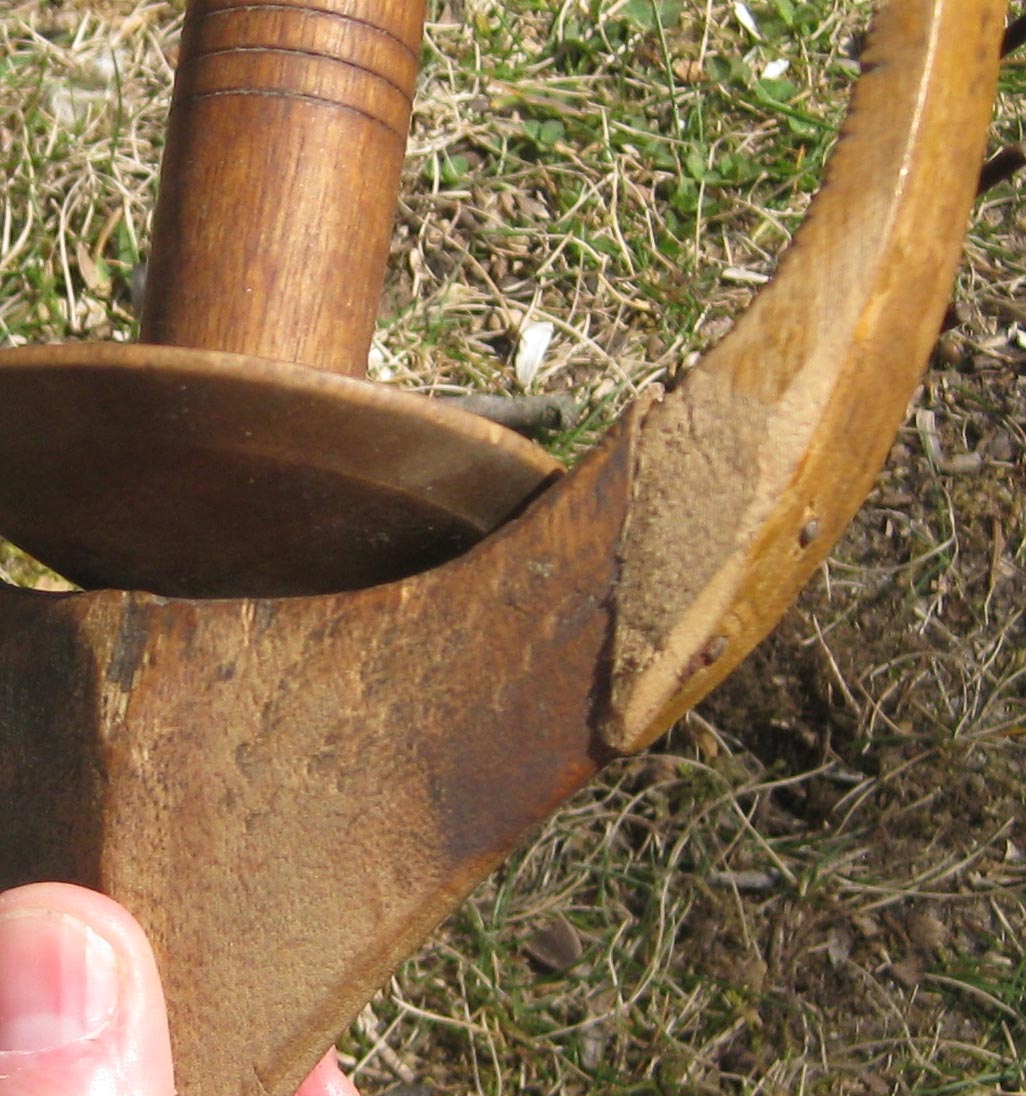
bisson mended flyer 02

Two nails. Not even glued on.

bisson mended flyer 03

Now, yes, someone made a brave attempt to repair this flyer. I’m a big fan of functional repairs, when they work. I think a functional repair adds character and shows the utilitarianism of a piece. But, like a Red Ryder b-b gun, you’ll put your eye out with this thing.

A flyer does just that — it flies while you are spinning. It will turn so fast, you won’t even see it moving. If you are spinning and paying attention to your fiber and this thing let loose, it could do some serious damage. One spinner reported that when her flyer gave way in mid-spin, it was flung across her living room and put a dent into the wallboard. Yes, they spin that fast.

Clearly, if Mr. Bisson was to be made to spin again, it would NOT be with this flyer. Additionally, the MOA mount was loose to the point of falling off:

bisson moa mount

The crusty old finish I could deal with, but the level of woodworking required was beyond my skill level. Therefore, the wheel was packed off to Fred Hatton, a marvelous woodworker in Pennsylvania who is the hero of many a spinner with an antique wheel. Fred builds replacement parts.

After summering in the Poconos, Mr. Bisson returned home in spinning condition with a lovely new flyer:

bisson 1

A faithful reproduction of the original Bisson, down to ridge on the flyer. The flyer shaft, bobbin, and whorl are all original; only the flyer arms are remade.

And the MOA repegged:

bisson 2

The wheel is a fantastically smooth spinner and having the craftsmanship of a new flyer only contributes to the smoothness:

bisson 3

While we are talking about missing bits and replacement parts, note that the maidens holding the flyer are NOT Bisson maidens; they are from a Canadian Production Wheel, probably a Bordua. The MOA is suspect, too, although it IS Bisson, judging by the little “pine tree” tip on the left. The wrong maidens and suspect MOA contribute to a lower value for this wheel and are points I was able to use to negotiate a very reasonable price for this wheel. The reasonable price was necessary to off-set the cost of having the new flyer made.

Next thing is to clean this crusty old piece, something I am not exactly looking forward to, given that it appears to have a red milkpaint finish on the bench. This will be a tricky restoration, something that will further contribute to the cost of this wheel. By the time she is done, I will have probably $400 invested in her, a price she will not command on the market so she no doubt will stay with me for the immediate future. Fortunately, she is an excellent spinner so she will be put to work when she is cleaned up!