Oops, I Did It Again!

April 14, 2011

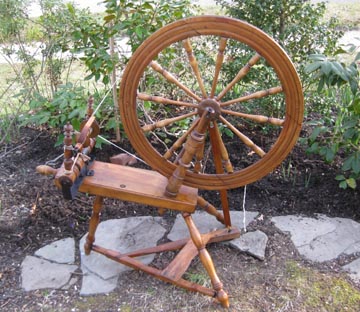
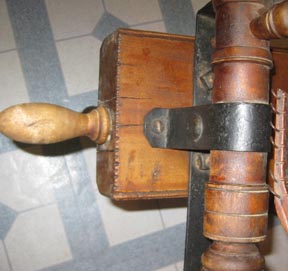
Well, okay. Did I need another wheel? Hmm, probably not. But I didn’t have a bulky spinner. And I was trolling around on Craigslist and somehow got out around British Columbia, where bulky spinners are not uncommon, and well, um …

The seller was most accomodating. Truly, you can meet the nicest people in the world buying spinning wheels. This belonged to her husband’s Aunt Stella.

It was the most beautifully, well-packed box I’d gotten in a long, long time.

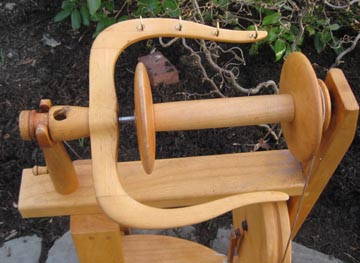
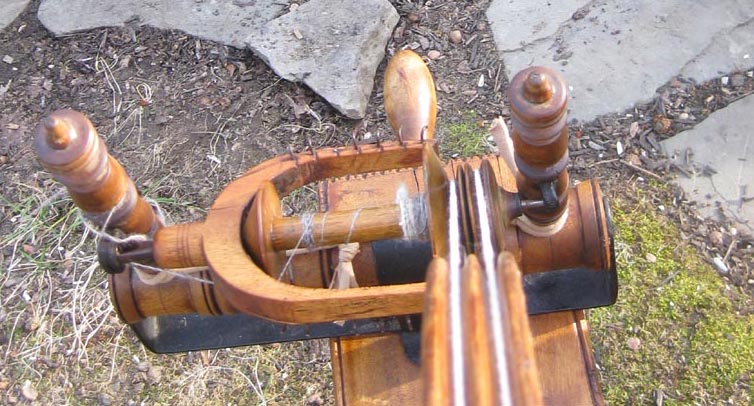
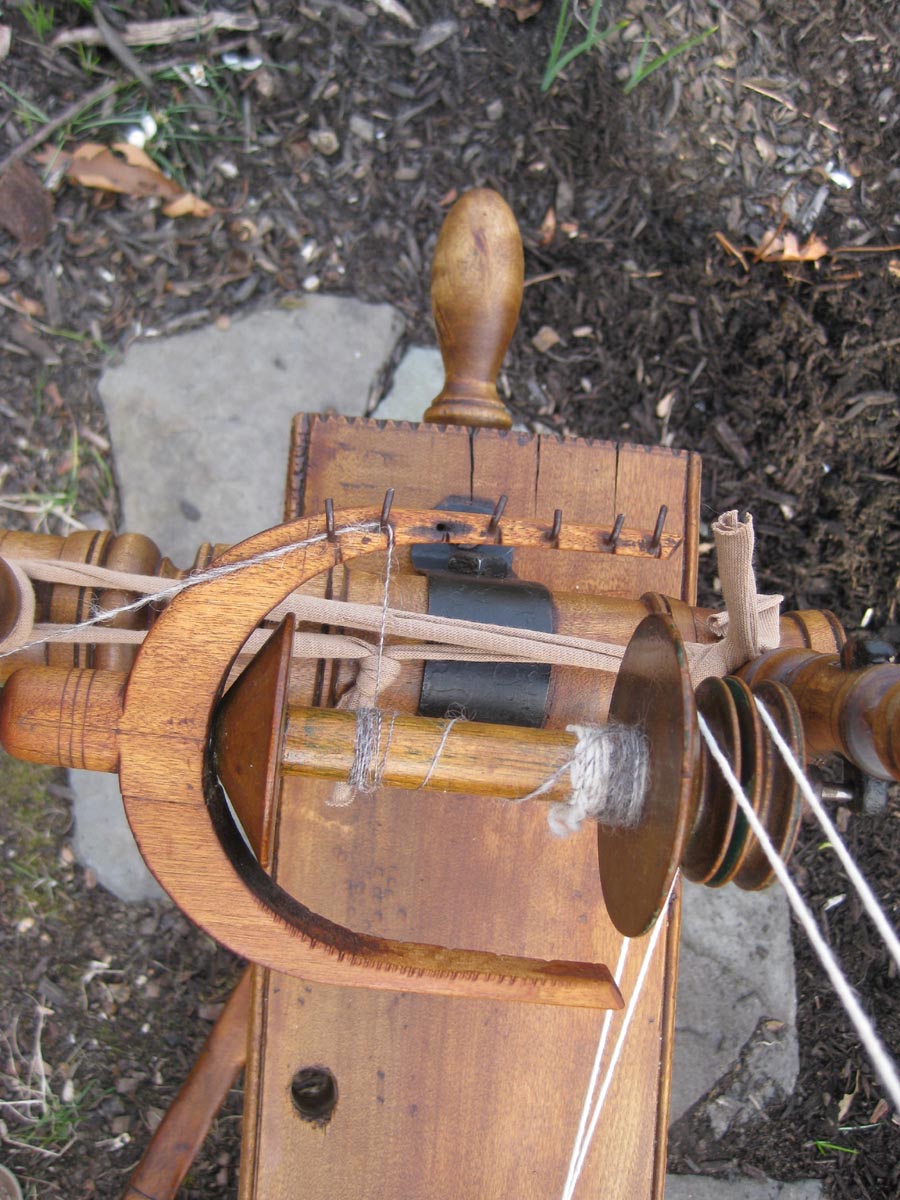
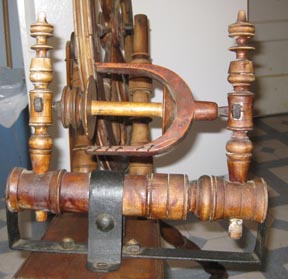
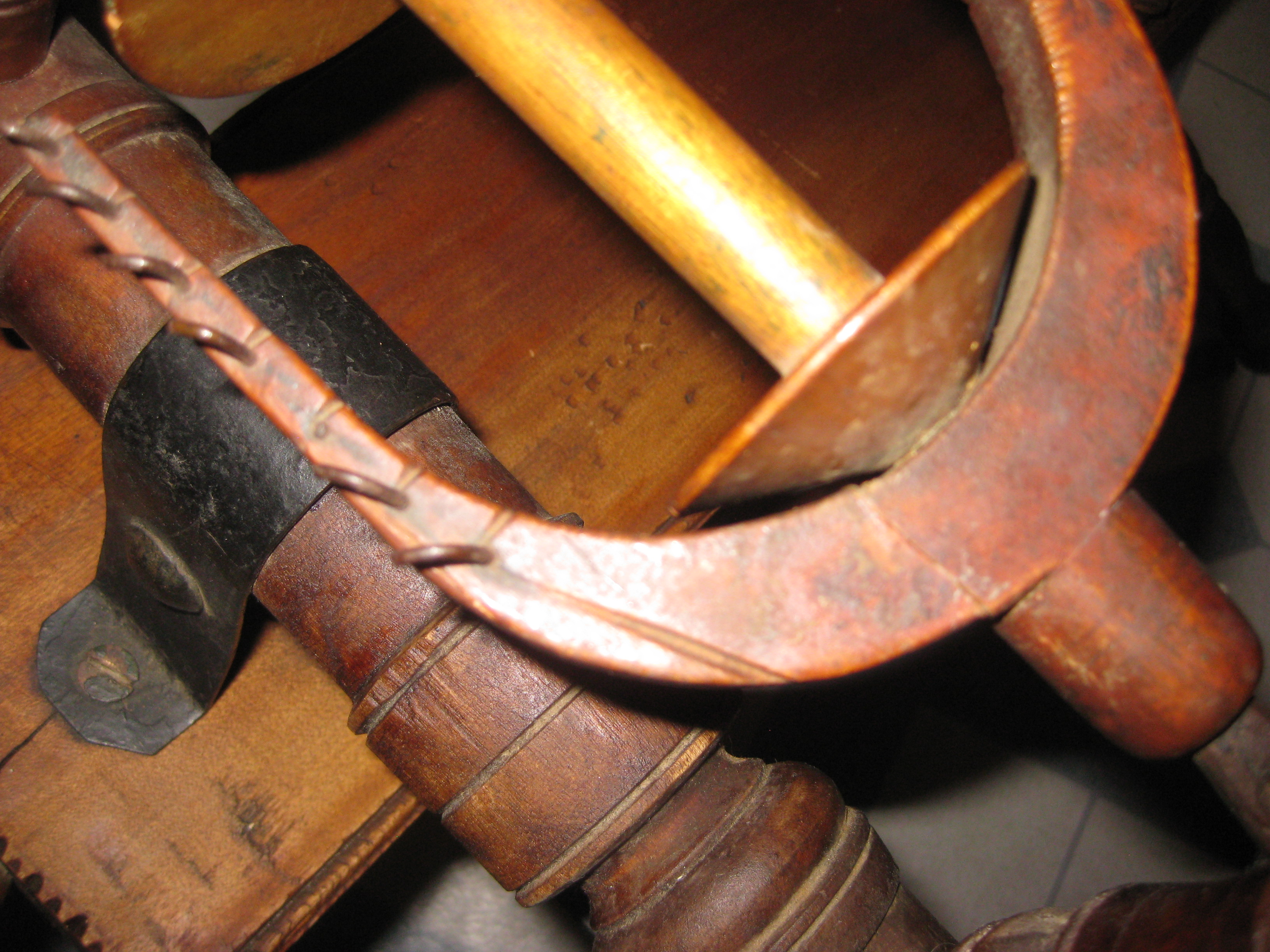
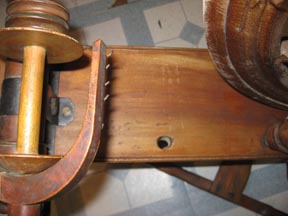
Love the graceful flyer — my husband said it reminded him of Nero’s lyre …

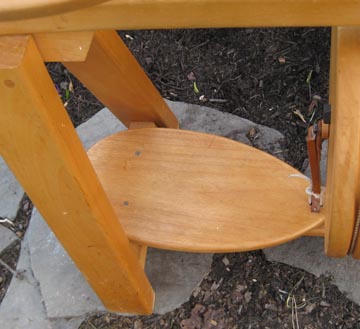
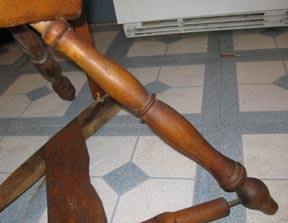
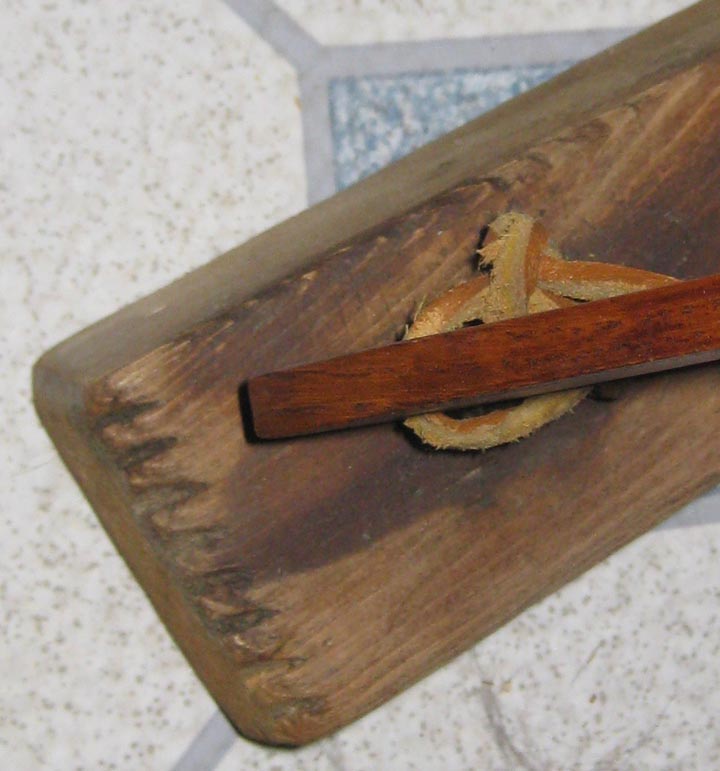
And the treadle looks a bit like the paddle of an oar …

Someone thought this might be what is called a “Mud River Spinner”?  If anyone knows the lineage of this wheel, please let me know. In the meantime, I just enjoy looking at her!


Bedelia and Friends

April 3, 2011

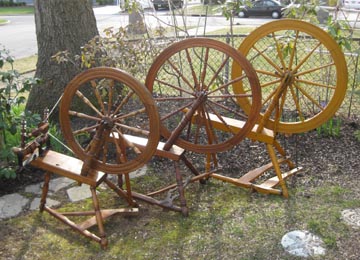
Bedelia, the supposed Canadian Production Wheel, has been enjoying her vacation at the Jersey Shore. Next week, she will be traveling to her new home in North Carolina. Here she is visiting in the front garden with some of her bigger girlfriends, Josephine and Daphne:

Top right is Daphne, the double-treadle CPW marked JO and painted yellow. Center is Josephine, the CPW I had before I even knew what a CPW was. Bedelia is in the foreground.

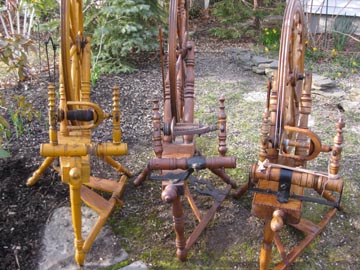
Here they are from the front.

And here is Bedelia, freshed buffed and fluffed and ready for her journey:

She is a smooth spinner. Her legs and uprights needed a considerable bit of shimming with leather, but are now straight and strong. Her maidens need new leathers and are a bit wobbly, but that will be dealt with. I was pleased to get her wheel lined up this straig

She cleaned up nicely and spins a fine thread:

Overall, she is a solid spinner and there is still lots of life in the old girl yet!


Bedelia’s Spa Vacation

March 28, 2011

This was a busy weekend with a trip to a sheep shearing, but on Sunday afternoon Bedelia, the possible Canadian Production Wheel, got a spa treatment. Poor girl, she was bit tired looking and loose in the joints. A good sprucing up does a world of good.

One of her issues was loose uprights. After another, more thorough cleaning with Murpy’s Oil Soap, I examined her uprights and discovered they were shimmed with square-headed nails. One was so loose, it lifted right out:

Her flyer assembly also was in need of cleaning. Here is how she appeared,  halfway through the “de-gunking” process:

She is missing two hooks, one on each arm. Curiously, it is the same hook on each arm — third from the bottom — not sure why that would be. She also has a mended split that is almost visible just below the flyer axle. But for her minor flaws, she is in good shape otherwise. See that lovely wood that has been hiding under the mottled brown finish?

Bedelia reportedly was painted green at one time, stripped and refinished. I am unsure as to what she was refinished with, but did find remains of her former green self. It appears that whomever stripped her did not realize the whorl would unscrew and that you could remove the bobbin. This was probably a good thing, as the whorl is in excellent shape. I did put on a few squirts of WD40 and let her sit for about an hour; she unscrewed relatively easily. However, she was still green between whorl and bobbin. I decided not to remove this; it was really heavy-duty paint, you can’t see it externally, and it would serve as a reminder of her past.

Perhaps Bedelia’s froggy friend is contemplating the fact that is is not easy, being green …


Look What Followed Me Home … Again

March 21, 2011

I really didn’t need another wheel, having somewhere in the vicinity of 35+ at the moment. However, this one showed up on the local Craigslist, the person who had it didn’t know about wheels, it seemed a bit unusual, my compatriots on the Antique Spinning Wheel board of Ravelry were curious, etc., etc., and so, here is Bedelia home in my kitchen:

The big debate was, is this a Canadian Production Wheel or not?

The drive wheel is 25″ across. The tensioning is a bit odd, being termed “muffler strap” tensioning by the ASW people:

There is a tensioning screw knob, but no screw tension. Some nice chip carving at each end of the bench and a beaded edging on either side:

When I removed the MOA, there was no hole drilled into the bench to hold a Saxony MOA, so clearly, this is the intended tensioning device.

Her flyer had the ubiquitous mended crack on it, along with an elegant groove for the yarn. She is missing the same hooks on each arm:

Unfortunately, she appears to have been shot through the heart. Some muggle has drilled her bench, possibly for a distaff but not in the typical spot for a distaff:

Her wheel hub is in good shape, as is the crank. The footman is a replacement. Several of her spokes need to be renailed and both uprights are loose:

She has long, shapely legs and elegantly turned ankles:

And her treadle shows sign of considerable use:

Even the tip of her treadle is chip-carved:

Chip carving on the back end of the bench. There are also two small spots that look like someone many years ago tried some wood filler, one spot of which has now fallen out and left a tiny hole:

The right back corner of the bench, nearest the footman, is missing a small piece:

The uprights are nicely turned and inside the notches for the wheel axle are brass insets showing under the vestiges of green paint the owner said her mother had the wheel stripped of many years ago.

Overall, she is a nice, sturdy wheel with minimal structural problems and what she does have, like loose spokes, can easily be remedied. I gave her a quick once-over with Murphy’s Oil Soap to see what was under the grime. The seller said her mother had had the wheel professionally finished to remove the green paint, but this was a bit of a misnowmer: The wheel had been unfinished by removing the paint, but no new finish was ever put on, so she needs a bit of sprucing up in this department.

The big question was, will she spin?  I got a double drive band on her and started her up. Oh, will she spin!  She is fast as lightning, treadles smoothly, and did not throw the drive band. The wheel rims are in good shape with no splits. The uprights are loose, so she did have a bit of a wobble from this. But her wheel is not warped and she ran straight and true.

So, overall a nice wheel and looks to be a good spinner but the question remains: is Bedelia truly a Canadian Production Wheel?


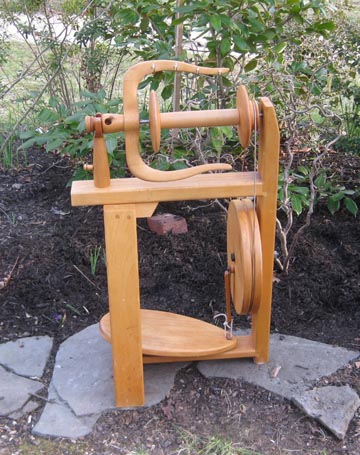
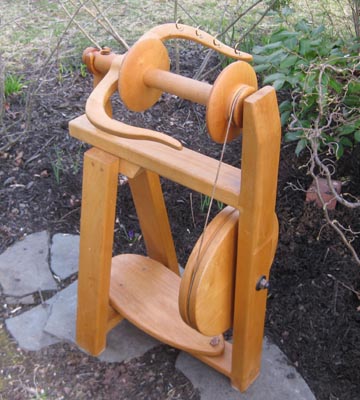
The Whitehorse Mountain Woodworks Spinner

March 19, 2011

Among my collection of wheels is this little artisan spinner:

It is a sturdy, fast little wheel with goodly sized bobbins and an interesting tensioning device:

The underside of the bench is stamped: Whitehorse Mountain Woodworks, D. Yeager, Green Spring, W. VA. and the zip code which my old eyes can’t quite decipher.

All I’ve been able to find out about the maker is this: Dan Yeager lived and worked in Green Spring, West Virginia in the 1970s and built these wheels from scrap lumber. No two are exactly alike.

If anyone out there knows anything about Mr. Yeager or these wheels, I’d love to hear from you!  So far, all I’ve been able to find are other people trying to find out more.


At last, it can be told … or, the Saga of the Socks

March 7, 2011

If the road to hell is paved with good intentions, then certainly these are the socks to wear on that road!

There was never a better-intentioned project, or simple. Two good friends, born and raised in a region with temperate winters, off to New England for their first winter there. What would make better Christmas gifts than socks — nice, warm, heavy handspun wool socks.

And since I knew in, oh, August? July? that they were going, certainly more than enough lead time, right?

The choice of wool should be easy. My personal preference for wool socks is Shetland and I have quite a stash. But, being special people, of course just any Shetland wouldn’t do, so I had to root around for something particularly nice. This is where I went wrong the first time. Well, the second time. The first time was putting off starting them until after Thanksgiving when I had had so much advance notice.

I found a few remaining skeins of a Shetland-Romney-Finn crossbred in a dark chocolate brown. It was an earlier spinning effort and had a tendency towards thick-and-thin. It also was an early processing effort, and was not blended so well. But this added to its charm — it had light streaks from the bleached tips and silvered swirls among the brown. It really was an interesting yarn and soft. I had used most of the fleece a couple of years ago when I knitted something like 4 dozen socks for the Buffalo Field Campaign in West Yellowstone, Montana. Socks field-tested to 50 below. I thought I had used all the yarn, but here were two and a half skeins that appeared to be more than enough for a pair of socks.

I then went wrong again when I decided to be clever and knit in a cable pattern. This broke my usual rule of “use a plain stitch to show off the yarn, or a decorative stitch to show off plain yarn.” The texture of the yarn was just not suited to a decorative stitch. I struggled dutifully on. I had remembered knitting the socks previously on a size 4 needle, and was using my new Kollage square DPNs but the yarn seemed bulkier somehow. I wasn’t getting the stitch definition I really wanted. Plus, I was getting a sock for the 50 below climate — the leg could probably stand up by itself.

I also was coming to the end of the first skein, which was a bit disconcerting. It was ending quicker than I expected. I had only reached the ankle of the sock when it ran out and I started on the second skein, hoping I hadn’t misjudged the amount. Turned out I need not worry. After two or three rounds of the new skein, I could see it was a completely different color. I held in the sunlight. I held it under a lamp. Nope. Definitely a different shade, and noticeably so. After a certain amount of wailing, I realized I might not have had enough anyway and decided to give up the whole thing as a bad bet.

Back to the drawing board and my wool stash. Now, the clock was really ticking. There was other Christmas knitting projects being done at the same time, and one unexpected request for an entrelac scarf. Simple socks were going to definitely be the way to go now, no messing around and showing off with intricate cables!

I found several large skeins of gray Shetland from Windswept Farm’s Lucretia. Lucretia’s fleece was interesting in that it had a very wide range of coloration from pale silver to black. I had blended the fleece prior to processing, the processor had blended the fleece, and we still wound up with a variegated roving which had not balanced out much in plying.

I started off right away with Lucretia and my usually k1, p1 rib for three inches and then switch to a k3, p1 rib for the length of the leg. I made headway alright, pounding away at those socks and alternating with the other projects. It is a wonder that part of the sock was not worked in entrelac stitch, I was so programmed to it at that point.

We now were rapidly approaching Christmas and there was clearly no way I was going to finish two pairs of socks, wash and block them, and parcel them up in the mail before December 25th. I contented myself, therefore, with expecting to spend time on Christmas day and immediately thereafter finishing the socks and trying to get them in the mail by New Year’s.

Except, who knew we were going to get so pounded with snow that no one was going anywhere for the next week, at least?

On Christmas afternoon, it began to snow. And snow. And snow. The storm was spectacular enough to sit up half the night tracking it. By midnight, we had white-out conditions and the plows had to stop and wait for the storm to abate. When we went to bed around 1:00, there was over a foot of snow on the ground. When we got up in the morning, there was 32.

Now, you would think, great, snowed in, can’t go anyplace, stay in and knit. It didn’t work that way. I was too agitated to knit. I didn’t like not being able to get my front door open and felt trapped. It took two days to dig out and I didn’t get much knitting done in that time, nor in the rest of the week. It was only after New Year’s that I settled down enough, finished the first sock and started on the second one.

I was almost finished the second one when I realized something. It was a different color than the first one. I thought I was hallucinating, or perhaps had gone permanently snow blind. The wool definitely was from the same fleece. I put all the skeins together to compare them. They all matched, but were all just vaguely different. The variegations of the fleece were such that you could knit with the wool and come up with different colors. Now, this is truly what makes handspun, handknit items one-of-a-kind but it was completely unintentional and I did want to make matching socks.

I was too far along at this point to change horses, or fleeces, again, so I forged ahead. The snow melted, it snowed again. That started to melt, it sleeted, everything turned to ice and then began to melt again. Finally, I got one pair finished. Washed, fulled, and blocked they only seemed a different color in indoor light. Outdoors, you didn’t notice the change as much.
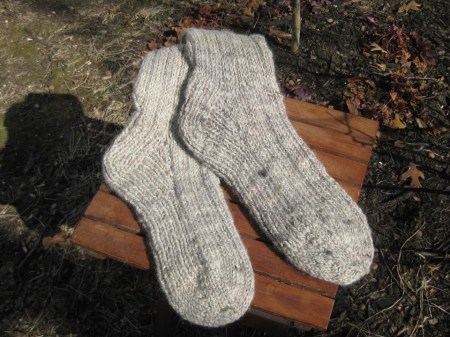
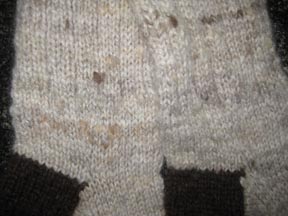
Well, maybe one is a bit more silvery.

Or not. In any event, I had myself one pair of sock, now onto the second ones.

At this point, by the way, I was aiming to make these now Valentine’s Day presents. That didn’t quite happen either.

I rooted around in my stash again and found a real treasure — Zoe. Zoe was a mioget ewe from the Heart of the Valley Farm in Oregon. They were one of my first finds when I began networking with breeders and I got some very nice Shetland fleeces from them over time. Unfortunately, they developed a following and I seldom am quick enough these days to get a fleece from them, but I still have some finished yarn from their flock tucked away. I had been saving Zoe for a special occasion and this seemed to warrant finally using her. I wasn’t entirely sure of the yardage; there looked to be enough. However, to be on the safe side and just to be a little creative, I had a skein of Cocoa’s fleece — a dark chocolate brown. I would make the sock from Zoe with a toe and heel from Cocoa.

I finished one sock. Zoe’s fleece was also variegated, ranging from a cream to a brown. It made a nice tweedy effect with the dark brown spots mottled into the lighter cream. One sock finished, and the ribbing of the second one begun.

The weather by now had begun to break, and we were able to get back out on the road again for weekend adventures. The day before Valentine’s Day, we set out for New Hope, Pennsylvania. This was enforced knitting time and I was busting to get my second sock down. In the bright sunlit car, I pulled the two rolled skeins of Zoe out of my bag.

What were the chances? Even with a variegated fleece, there is a chance that the color will even out during plying. It would be a really odd occurance to have two really light singles just happen to come together at the exact point in time and space to create a light colored two-ply strand.

Clearly, the stars were against me on this one. I stared out the car window, mulling this over for awhile, when a little bell went off somewhere in the recesses of my long-term memory. Whether I dreamed it, or read it someplace, or lived it in another life, I have no clue, but somehow I recalled when knitting with handspun, you knit one row with one skein and then next row with another skein and by alternating, you prevent any pooling or separations in colors.

I had nothing to lose at this point, and so started in with the second skein. The problem was with knittin in the round. After about three rows, the switch of colors was leaving a definite seam. To avoid this, I advanced one stitch every row when I switched skeins. This avoid a seam down the back, but created a bit of a spiral pattern on the inside of the sock. At first the skeins were pretty even in color and so the shaft of the leg didn’t show much variation.

Suddenly, using the brown for the heel and toe seemed a really good idea because the sudden block of dark color also bounces out and distracts from color differences in the lighter section.

As luck would have it, the skeins were going in completely opposite directions, colorwise. As I knitted along, one got progressive lighter and one got darker. By the time I was in the homestretch on the foot, you could start to see some striping.

I finished with about 3 yards left of the very pale cream. Brown toes, close up the seam, and they were ready to go into a hot bath.

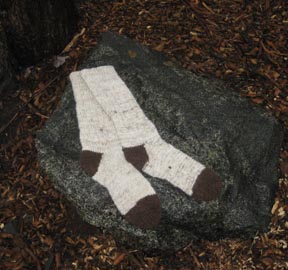
Washed, fulled, and blocked, they appear the same color, particularly in natural light although if you look closely enough, you can see the vague striping on one foot.
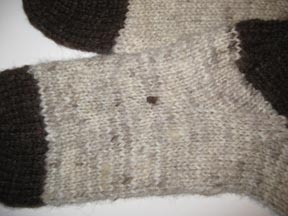
Regardless of color variations, the socks are nice, heavy, warm handspun wool socks out of 100% Shetland, so they meet the initial criteria of the project. The next time, I guess I will need add “matching color” to the list!
The Newest Arrival

February 28, 2011

Okay, so first off, yes, I needed another spinning wheel like a hole in the head. I can’t spin on more than one at a time. They take up room. I don’t have time to refurbish the ones on my workbench. Etc., etc.

However, every so often something comes along that just won’t be ignored. This was the case with the newest arrival, a Hemlock Hill Handspinner.

She may not be a beauty, but she sure can spin!

Several years ago, before I knew what this wheel was, I purchased a similar one on Ebay. I received an e-mail from a woman who had been watching the sale. Her father had been the wheel’s designer and she let me know that the wheel I had won was a prototype. Of course, ever since then, that made me want to see what the final version turned out to be and here it is.

The wheel was designed and built by retired engineer John Woodward of Maryland. Woodward and his wife ran the Hemlock Hill Farm for many years. They raised Romney sheep. Additionally, Woodward is credited with being one of the people instrumental in founding the Maryland Sheep and Wool Show. In the mid-70s, Woodward took on the challenge of building an affordable, sturdy wheel and the result was the Hemlock Hill Handspinner. One feature is the extra-wide treadle which allows the spinner to comfortable treadle with both feet and which, I was told, accomodated his daughter’s size 10 feet.

Another feature is the reversible bobbin.

As the wheel came to me, the smaller pulley end of the bobbin is near the orifice.

The larger end and the tensioning screw.

But the most interesting feature is the flyer.

No, that is not a Woolee Winder. Woodward’s daughter explained that her father never thought to patent this flyer design. He was just looking to build a better mousetrap, as it were. It was not until later that another maker introduced a similar device.
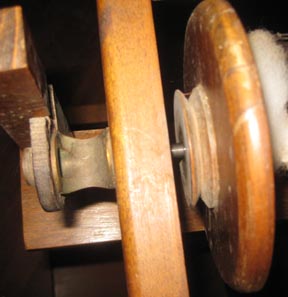
Overall, the wheel is in good shape. The connector for the treadle and footman is a piece of leather similar to what the older Ashfords have and it is snapped, so I will replace that. The tensioning screw appears to be a bit warped; the bottom is not seated straight and I will need to examine this a little closer. Other than that, it spins fine and just needs a little clean up. It came from an estate sale in Clarksburg, Maryland; the former owner’s son was not sure if his mother knew the Woodwards or not. She raised angora goats and attended the Maryland Sheep and Wool Show, so she may well have gotten the wheel there.

If anyone else has one of these spinners, I’d love to hear from you, especially where you found it geographically. Both of mine came from Maryland within 50 miles of each other. I’m wondering if there are others out there that found themselves further afield.


Gauntlets

February 21, 2011

I seemed to be fixated on gloves lately. Perhaps it is because I always viewed them as something difficult to make because of the fingers. However, having graduated from wristwarmers to fingerless gloves, it now seems the simplest thing in the world to just knit the fingers a little longer and — voila — a glove!

And, although I had found a number of patterns to plan towards making, I couldn’t find one for what I envisioned. So, I had to make it up myself.

I have a buckskin jacket with fancy beading and wanted something to go with it. Also, I have an almost-completed Annie Oakley cardigan from the “Folk Styles” book. That piece has embroidery around the cuffs and uses I-cord edging. The embroidery and I-cord are in Rowan Wool Cotton. I didn’t use the color scheme suggested in the pattern, but picked out something I preferred. In doing so, I stumbled across the Rowan Wool Cotton in pumpkin and in chestnut.

The pumpkin color is similar to the buckskin jacket, so when I determined to make gloves to match both jacket and cardigan, this yarn was the choice. It turned out to be an excellent one, I think, and I am enjoying working with it. Our progess so far:

In truth, I am using a smaller needle size. The yarn is supposed to take a 5 needle and I’m using 3. However, I like a firmer, tighter surface and this is turning out to have just the fabric texture I like.

The gauntlet part is in moss stitch, followed by a section of K1, P1 ribbing, followed by plain stocking stitch:

The big question was on the gauntlet part. I wasn’t sure whether to face the opening toward the side or put it in the middle along the underside of my wrist. I finally settled on the middle:

I think I will call these the “Blank Canvas Western Gauntlets.” I will finish this off with the same embroidery as on the cardigan and trim it will the I-cord edging to match. It is tempting to want to embroider up the back of the hand, too. There really are a lot of ways to trim these. Hmmmm … may have to make a second pair!


They’re Done!

February 16, 2011

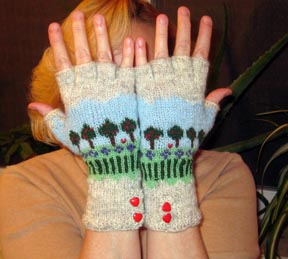
The Rainy Day Fingerless Gloves, as cited in an earlier post, here in their finished state:

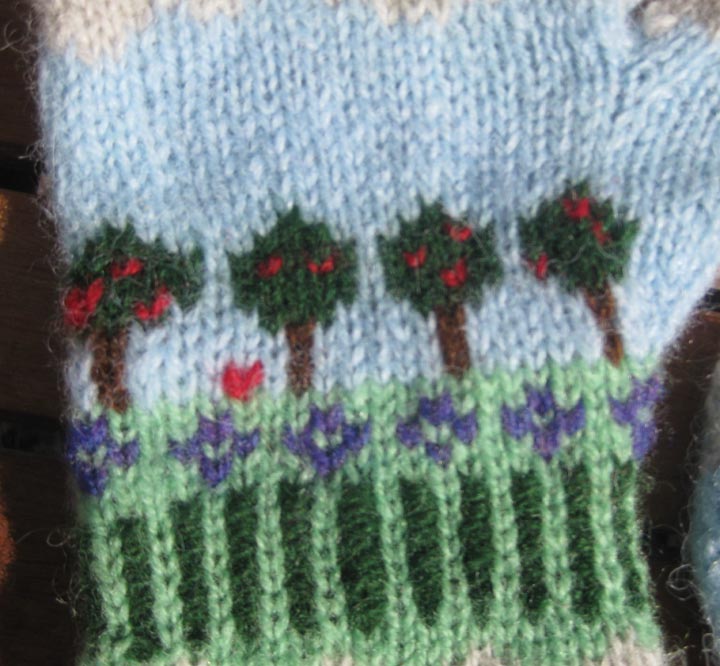
I left the rain out, however. The sky part had little half-stitches duplicate-stitched in; they were supposed to be cobalt blue. I decided I’d rather have Sunny Day Fingerless Gloves. And the little apples are cute, I didn’t want to detract from them:

The Jamieson’s Spindrift Shetland fulled, bloomed, and softened beautifully. The gloves are a tiny bit tight, but I have small hands, so it is okay although I am making a second pair in a different yarn and added 5 stitches. It feels better with the additional stitches. The pattern was sized only for small, so some experimentation is necessary to size them better. However, I’m happy with the results and my hands are warm now while driving!


Twist New Hope, PA

February 15, 2011

A couple of weeks ago, my husband and I went on a sort of cook’s tour of New Jersey and eastern Pennsylvania, stopping at yarn stores and used book stores along the way. I knew there was a knitting store in New Hope, PA, but had never been able to find it. However, having acquired a Blackberry, I was able to Google up directions while on the road and track down the shop.
Fast forward a few weeks. Husband decides we should have bought the book on midieval clothing and armor from the shop in Lambertville. Sunday weather is nice enough (finally!) for a drive. Maybe we should go to Lambertville and New Hope? That’s fine, dear, we can visit that nice knitting shop again. So, the deal was struck and we set out.
After acquiring the book, we set off up into Pennsylvania. If you are not familiar with eastern Pennsylvania, it has some really lovely architecture. New Hope is a mix of Colonial, Victorian, and modern built to blend in. Along the highway is built up, but generally lacks the sprawling strip malls that New Jersey is famous for. Rather, the Pennsylvanians will restore and preserve an older house and make it a focal point of a shopping area. The colonial houses tend to be either fieldstone or clapboard and really do stand out when they are restored. It just makes for a so much more charming effect than miles of sterile big-box storefronts.

Twist Knitting and Spinning is located on Route 202. If you come from New Jersey, you can either come in on 202 or, if coming from Lambertville, come over the bridge to New Hope and stay straight; you will hook up with 202 a little ways outside the town. Route 202 is also called Lower York Road at this point. Stay on 202 for about 5 minutes. You will come to a hilly stretch and the shop is on your left, just after the crest of a hill. It is on the intersection of Aquetong Road and there is a light at that intersection. The light is a good thing if there is traffic, because it will give you a chance to navigate the narrow parking area.

Once safely parked, however, you find yourself in front of one of those lovely, preserved Colonial buildings. Does this not look like the ultimate front for a knitting shop? :

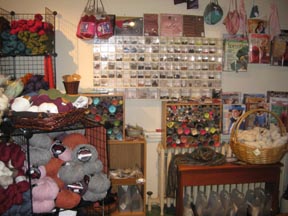
Anyway, if I had a knitting shop, this is exactly the type of window I would want! And look, it is just bursting with knitting and spinning loveliness!  Once inside, you realize exactly how much loveliness there is:

The original fireplace has been converted into display space. It is bursting with mohair, cashmere, and other fine yarns from makers like Madeline Tosh, Rowan, and Debbie Bliss.

The shop is cleverly laid out to take advantage of the small space. Every nook and cranny is filled with the most wonderful yarn.

There was even this gorgeous Lady Eleanor wrap from the “Scarf Styles” book on display.

And, if you wanted buttons, you came to the right place:

There is a nice selection of needles displayed behind the checkout counter. Believe me, not an inch of space is wasted here! A largish space is set up like a living room with comfy chairs and was filled with knitters. I did not bother them for a photo, as they seemed so happy to be chatting on their projects and I had already burst through them a couple of times with yarn and roving from the back room.

A little back room is filled with spinning supplies, a loom, books, yarn, and a discount shelf full of treasures. A woman was peacefully plying yarn at wheel and looked so relaxed, I also suppressed the impulse to whip out the camera.

I actually had a goal for this trip, which was to secure some Rowan Kid Classic for a pattern I’d just seen in one of the One Skein Wonder books. It turned out that Rowan is discontinuing this yarn and Twist had it on the discount shelves, so I happily bought enough for several projects.

Cissie, who was overseeing the shop and the knitters, cheerfully kept me supplied with shopping bags, weighed out my blue-faced leicester roving, and directed me to the shop’s Ravelry group while she rang me up. A most successful and pleasant yarn run! Twist is one of those LYSs you find, wish you lived closer to, and then realize it is probably better you don’t because you would never be out of the place.

Used books and yarn stowed safely in the trunk, we returned to the little Village of New Hope. If you have an opportunity to visit Twist Knitting and Spinning, make sure you head up the road and visit the village, too. There are some great restaurants. Our old standby, Karla’s, was packed, so we headed to the other side of town to the Triumph Brewery. We figured beer and a burger, but were again pleasantly surprised. We ordered the microbrew sampler — 30 ounces total of all their brews — and wound up ordering off their dinner menu just because it all sounded so good. That’s when we found out how good the food is here. It will be a tough choice the next time we visit as to which spot to eat at!

If you are nearby and looking for a day trip, I can’t recommend this enough. If you are nearby and looking for a good LYS, don’t hesitate to look for Twist! It will definitely be worth your drive.