Nostalgia

February 4, 2010

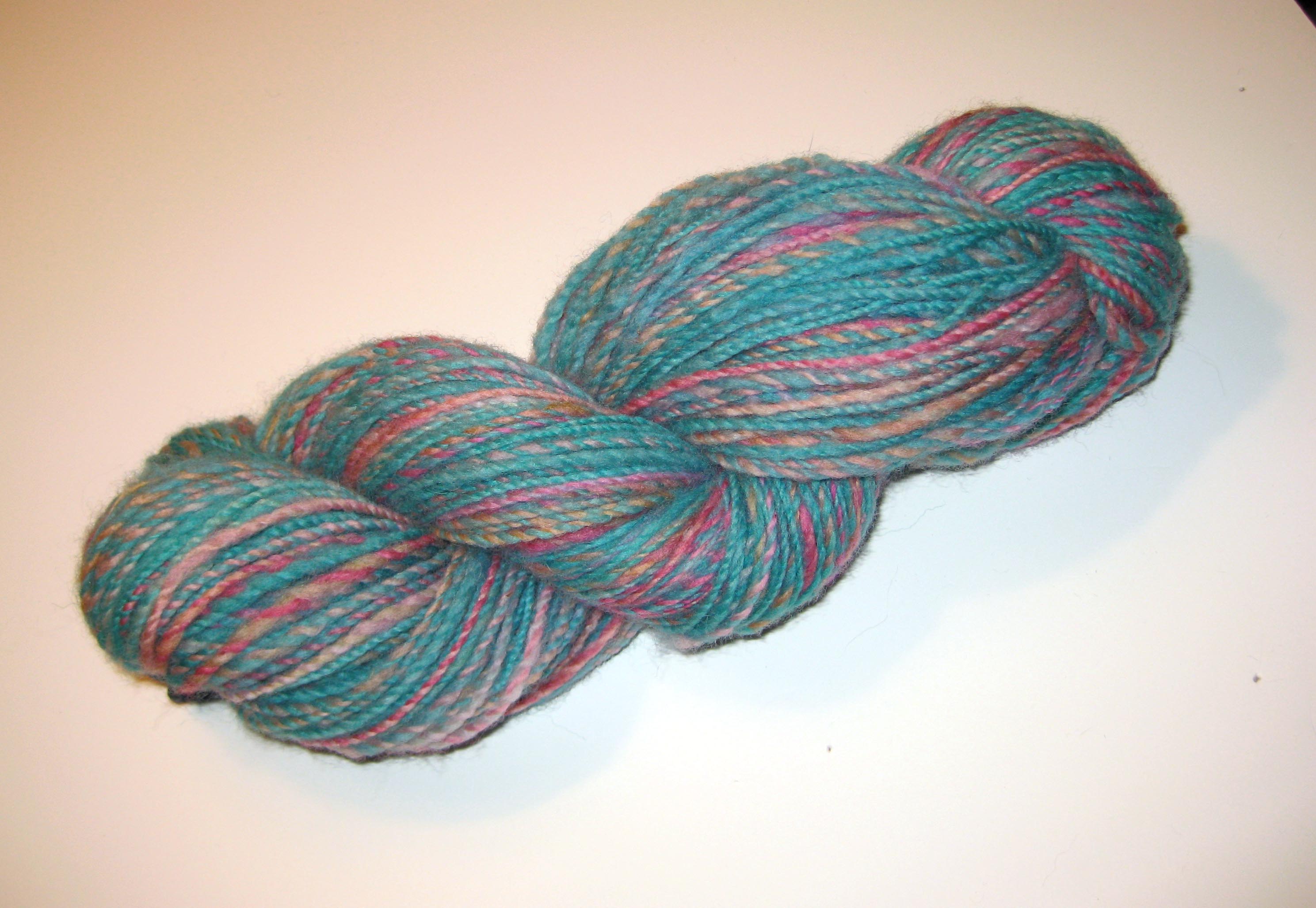
I recently got to chatting with a new Ravelry friend who wants to learn to spin. I offered my standard caution to not worry about what her early spinning efforts would look like. Just so everyone understands, this is the first skein of yarn I ever spun:


A little different than some of my more recent efforts. When I first started spinning, I demonstrated at a local farm for their Sheep Shearing Day. People were agog and had no clue what I was doing, so clearly, any spinner, even a bad one, was welcome.

In exchange for spinning, the farmer gave me as much wool as I wanted. This was about the time the Wool Pool in New Jersey was being discontinued. The farmer raised Dorsets and had them on an accelerated lambing program. Consequently, he had a considerable number of fleeces to give away. In fact, the helpers offered to carry the ones I wanted to the car. They followed me to the parking lot, at which point I realized they were carrying not just the fleeces I wanted, but every doggoned one of them! I think I wound up with 36 free fleeces, Dorsets, Suffolks, and crosses thereof.

Anyway, it was a good way to start spinning, as I was working on not expensive wool so if it didn’t turn out right, it was not such a loss as if I were spinning merino. And it turned out that Dorset is actually a nice middle-grade wool, very bouncy, and makes great socks, so much of that early wool turned into nice, serviceable yarn. Not very exciting, but very utilitarian.

This first skein was one of those Dorsets, not very well washed so it still has a little lanolin in it. Overtwists and under twists abound – I did not ply this, it was a single strand, but it sure plied itself!

And, of course, if I wanted to go back and make a yarn like this now, think I could do it?

Enjoy these custom-spun, one-of-a-kind beginner novelty yarns – they happen once in a lifetime!


Skein finished!

January 31, 2010

As you recall from a previous post, the blue tweed handspun socks were going to be delayed for lack of yarn. I had to spin more, but there was already something else on the spinning wheel. Yes, I could have used a different wheel for the blue tweed, but like to keep the same wheel for the same yarns.

And the project on the wheel was only one ball of roving’s worth, one of the results of a day’s dyeing back in the fall. It did not take too much time to spin up the second bobbinful and ply them. Here are the results:


Taking Risks

January 30, 2010

Sometimes, one must take risks in knitting, as in life in general. Today was a good example.

My husband and I decided to have a bit of a date: go out to lunch and take in a movie. First, an errand to the local feed store for cases of Wellness Diet cat food and massive amounts of outdoor bird feed. That done, we repaired to a local watering hole known as The Cabin.

The Cabin does, indeed, look like a log cabin on its main room, but has been extended to be more modern off the back. We like sitting in the cabin-ish side of things, though. There is even a moosehead over the fireplace.

After lunch, we drove to the Milliplex or however many theatres are in the darn place, to see “Sherlock Holmes.” Now, don’t get me wrong, I enjoy going to the movies but sitting for over two hours when I could be knitting …

I started working on a new shawl in Berroco Peruvia. The color is a lovely green called “Sea Turtle.”

The pattern is something I’m making up as I go along. It involves a decrease towards the beginning and end of each knit row. Anyway, I was quite involved in the shawl and making progress and hated to put it down. I brought it along into the theatre in my knitting tote, figuring it would be light enough during the myriad of commercials and coming attractions to keep knitting.

It was light enough, and the theatre was a little cold, so it was nice to have a warm knitting project on my lap. When the movie started, I hated to put it down so … I didn’t. I kept knitting in the dark.

Risky?  Well, the tricky part was the seed stitch edging and the increase stitch just after and before. K1, p1, k1, p1, k1, p1, pick up stitch front to back and knit through the front. Knit the row and then do the reverse at the other edge. No increases on the purl row, but still the seed stitch border to contend with.

Going primarily by sense of feel, and knowing that even with the seed stitch, the knit row began with a knit stitch and the purl row with a purl, I kept at it. A couple of times, I had to slow down and really feel the stitch to make sure I was approaching it properly.

And, you know what?  Darned if it didn’t work!  I kept thinking when I got home, I’d find all the mistakes. But when I laid it out, I’ll be blessed, I couldn’t find a darn thing missing or twisted. A few loose stitches along the border, but these will even out when I finish the thing. Wow. Talk about dumb luck!

Of course, by the time we came out of the theatre, it was snowing like a son-of-a-gun and we had a half-hour drive home in a mini-blizzard. Nice to be home on a cold, snowy night with a warm, wooly knitting project to keep me occupied. Maybe a hot toddy, too?

Oh, and we thought the movie was pretty good, too!


The Current Spinning Project

January 25, 2010

 This is what is currently on the Jensen Tina. I am trying to finish it up so that I can do more of the blue roving that I will need to finish my socks. I completed this bobbin last night and started a second one.


This is what the roving looks like:


For the first bobbin, I spun directly from the ball of roving so each stretch of color is very long. To get a more marled effect, I broke up the roving into sections about 18 inches long and then split these down into four strips each. This puts the color changes closer together. Plied, it should give me more variation in color.

By the way, this was dyed with Wilton’s Icing Colors cake dye from the local craft store. I’m not a big dyemaster, having a very small kitchen, and chemical dyeing being potentially messy and smelly. This was a nice compromise and I’m generally happy with the results.


One Sock, Blue Sock …

January 25, 2010

Okay, halfway finished with the pair of socks!


The second one is already under way. I rewound the ball of yarn and realized I would need to spin more to finish the pair. Trouble is, there is another spinning project on the Jensen Tina. I will take time from knitting to spin finish spinning that project and do more of the blue. This is getting akin to a factory setting a production schedule!


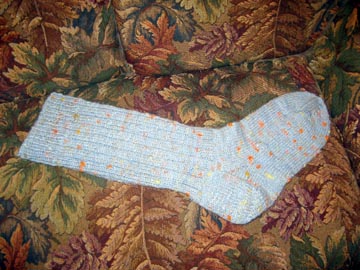
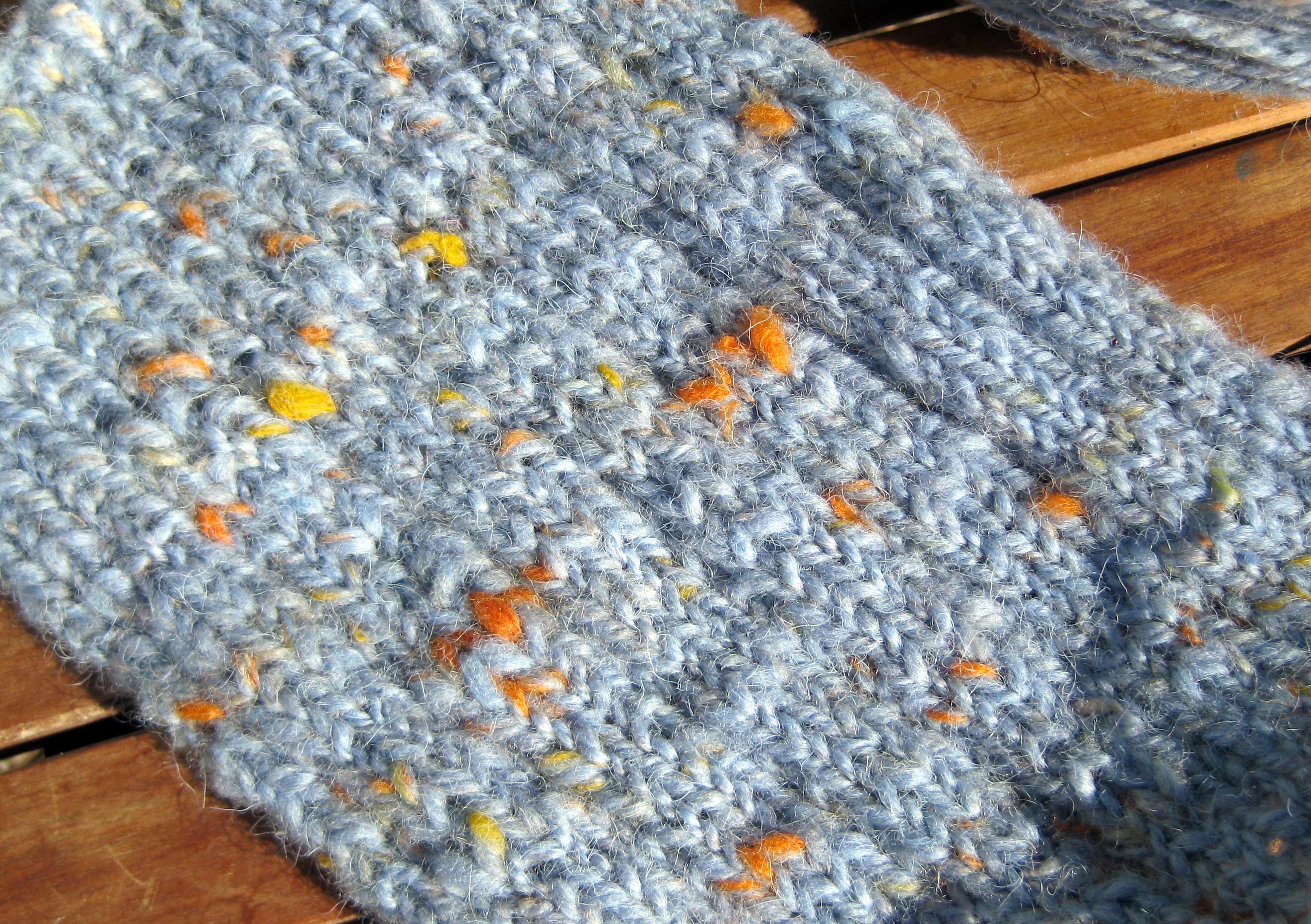
But I’m happy with the finished product. I should have thrown a bit more yellow into the thrum mix, but am pleased with the way the orange pops. There is something comforting about heavy wool socks on a rainy January morning!


Technical Difficulties …

January 18, 2010

“We are experiencing technical difficulties. Please stand by.” Remember these messages that periodically would come from your television set in the 60s and 70s? It meant that some sort of technical difficulty was experienced … like a technician had tripped over a cord and pulled it out of the outlet box … and the station had momentarily gone off the air?

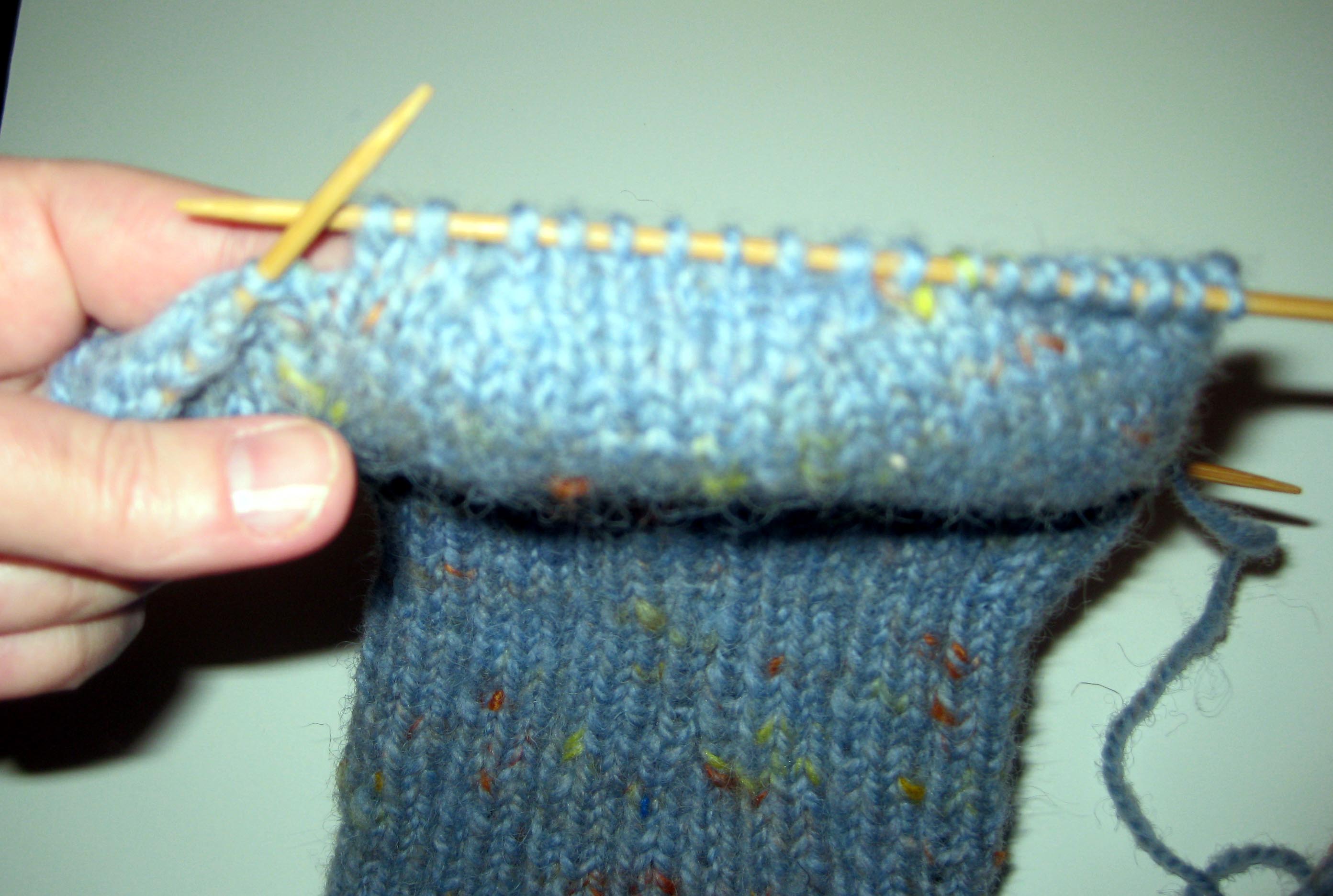
Well, I had hoped to have one finished blue tweed sock by the end of the weekend. On Saturday night, after knitting the complete gusset section and getting about halfway up the foot, I realized there was a skipped stitch sticking up. And, since I couldn’t ascertain where the stitch was or if leaving it out would mean terminal damage, I skewered it with a needle and frogged out all the work I had just done, up to that point.

Turned out it was a stitch in the row just one off from the pick-up row, so I had to go back pretty far. At least I didn’t have to pick up all the new stitches again. But once I got everything back on the needles, I sort of fizzled with energy to do the same thing over again. I am about halfway through the gussets, but took a break to work on something with bigger needles and a different color. Please stand by.

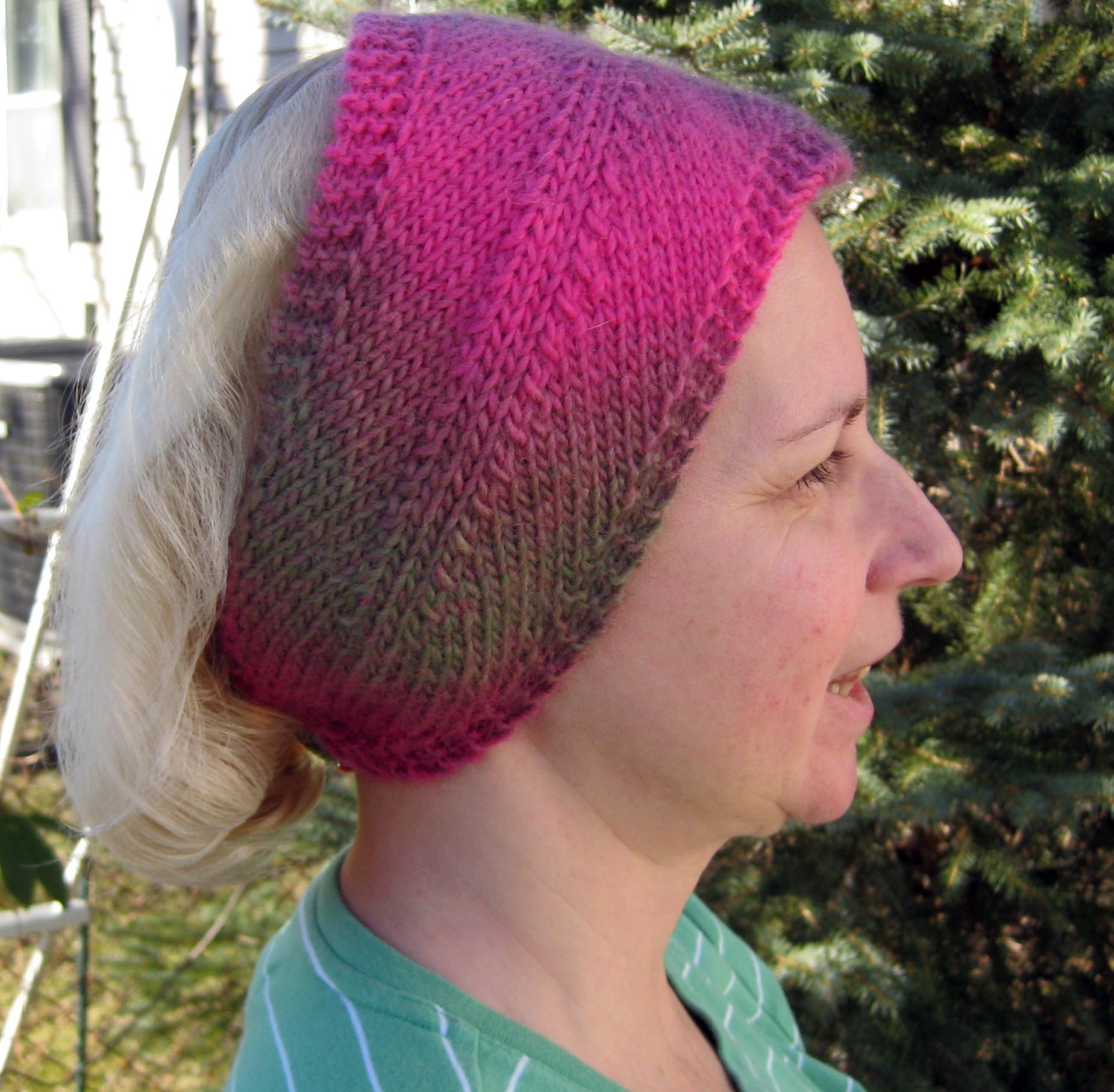
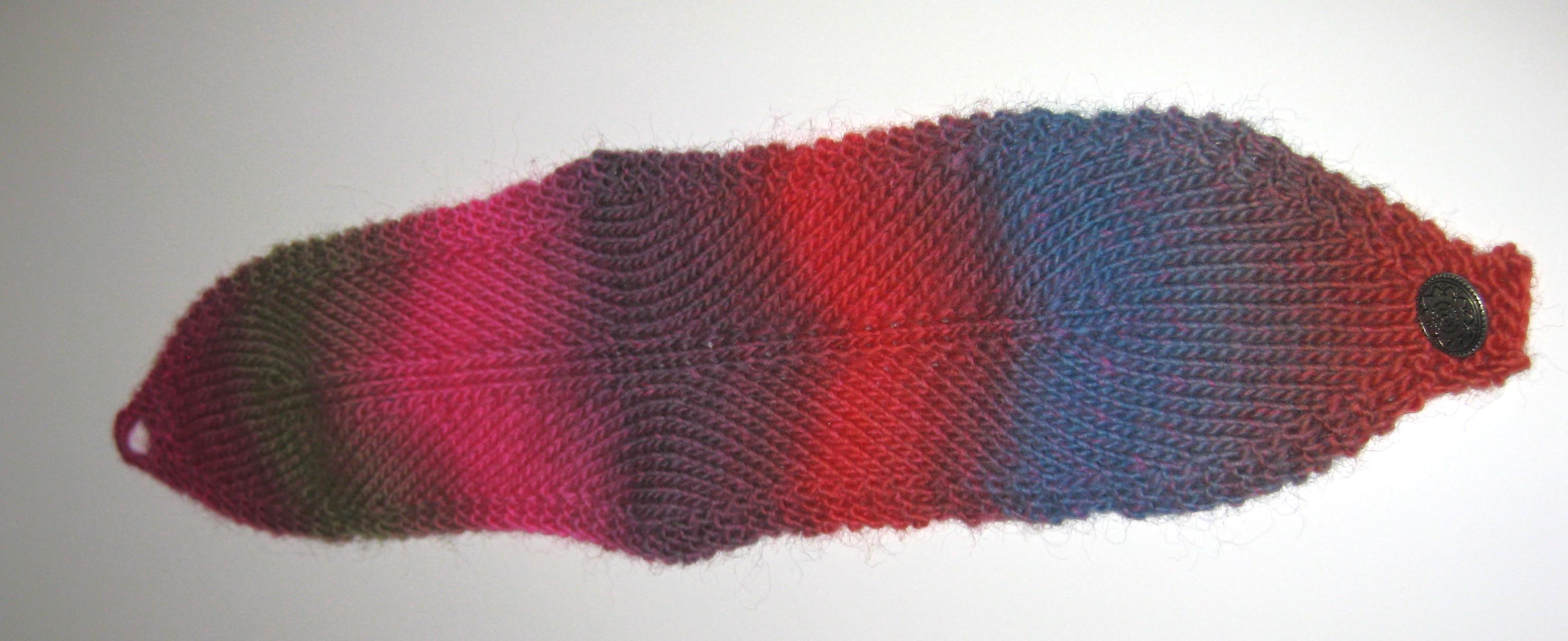
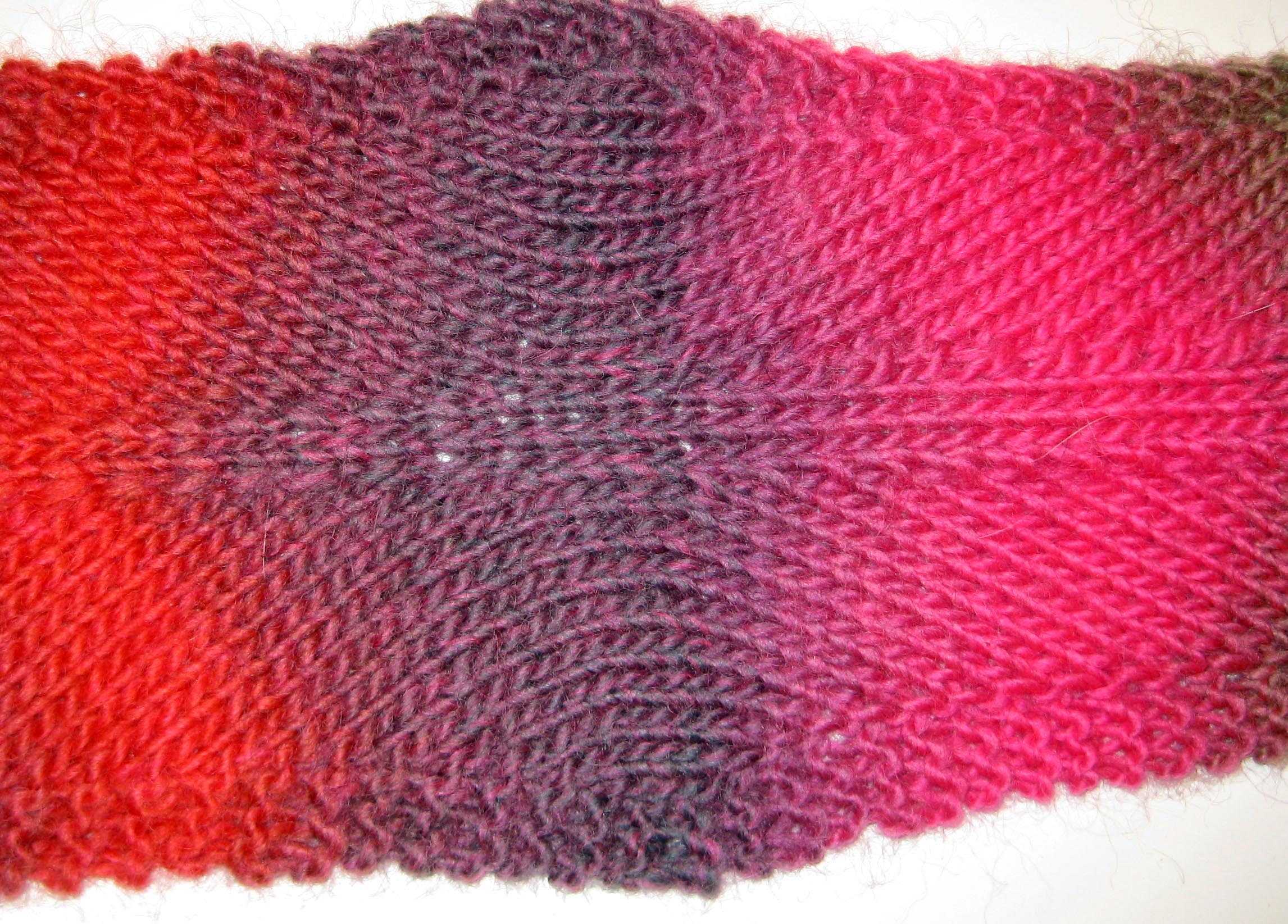
This headwrap from the book, “Handmade Underground Knitwear,” taught me more about shaping with stitches than anything I can remember. It is very simple to knit, as long as you follow the directions. Being an indifferent sort of knitter, I seldom follow directions. But I did with this one and am glad – it turned out great. It is recommended for Jojoland Rhythm, which I happened to have a skein of in my stash. I wasn’t completely happy with either the color or the length, so I made a second on in Wisdoms Yarns Poems and dropped out a couple of rows.

Voila! Instead of 19 repeats on each side, I did 18 and it made the finished wrap a little tighter. I would probably do 17 on each side next time.

I think the shaping is cunning – this finally made me realize the difference between SSK and K2T. And I love the way the top comes out in half circles!


Sock it to me …

January 16, 2010

Sorry for the rather obvious headline. My husband had on the local “oldies” station and they played the song of the same title by Mitch Ryder and the Detroit Wheels. Naturally, this launched a debate on who said “Sock it to me” first – Mitch Ryder or the folks on Laugh-In. If you are younger than, oh, say, 45, you’ll probably need to Google that up.

Work not withstanding, I managed to make headway on the blue socks this week. By Friday night, I had knitted the leg the right length and then turned the heel today. Here is the heel flap completed:


Note the center back of the leg. I tapered it slightly into the ankle by decreasing a couple of stitches an inch or so apart. I like doing this so the ankle is not too baggy.

When I knitted my first pair of socks, I had a little trouble figuring out how to turn the heel. I ripped out the first turning row a dozen times until it dawned on me: the stitches that you knit (or purl) together are the one from the previous row you knitted (or purled) together, plus the one you slipped. When you slip the last stitch before turning, it creates a little gap – you need to close the gap by knitting (or purling) two stitches together. Here is the two stitches on the purl row:

And here are the two on the knit row:

You put these two together, work the next stitch, and turn the whole thing around. Slip the first stitch and work the row to the next gap. Close the gap, work the last stitch, turn the whole thing around and do it again. When you have finished only one purl row and one knit row this way, you will see your heel already taking shape:

And once you have worked back and forth the entire width … ta-da! … a heel!

Then, you need to set about getting everything back onto the three needles so you can do the foot. Pick up along one edge:

Knit across the next needle, pick up the other side and halfway across the heel. Put the stitches left over on the heel needle back on needle one and you are ready to go:

The one thing I didn’t like, I’m using a new pair of Hiya Hiya bamboo needles, size 2, and they have already warped. The regular old A.C. Moore Clovers work much better.

Anyway, I’ll try to have this sock done tomorrow!


Socks

January 10, 2010

I have built up a network of sheep breeders and farmers during the time I have been spinning. One is gentleman in Maine who I found through a homesteading and country life message board. He had a small flock of Shetlands that he kept primarily for meat. They were sheared every spring and his shearer would take a fleece or two and the other 5 or 6 would go in his shed. I figured it would be much more productive if the other fleeces went into MY shed, so we struck up a deal where I would buy his whole clip every year.

This turned out to be a great arrangement, because the wool was fabulous. Typically, there would be two moorits, two grays, and one white, with an occasional one or two others. One of the gray ones became my all-time favorite fleece to spin.

This past spring, the farmer informed me that as the Shetlands were getting old, he had gotten rid of all but one and replaced them with white Corriedale crossbreeds and would I like to take a chance on those fleeces? Well, I never met a fleece I didn’t like, so I took him up on the offer and bought the last of the colored Shetlands along with 3 white crosses.

Having become adventurous enough to do some dyeing, and finding that the white fleeces were quite large, I immediately washed and dyed one. I was after a light blue color and used the standard blue from Rit Dye, but only a small amount. The results were perfect – sort of a light denim blue.

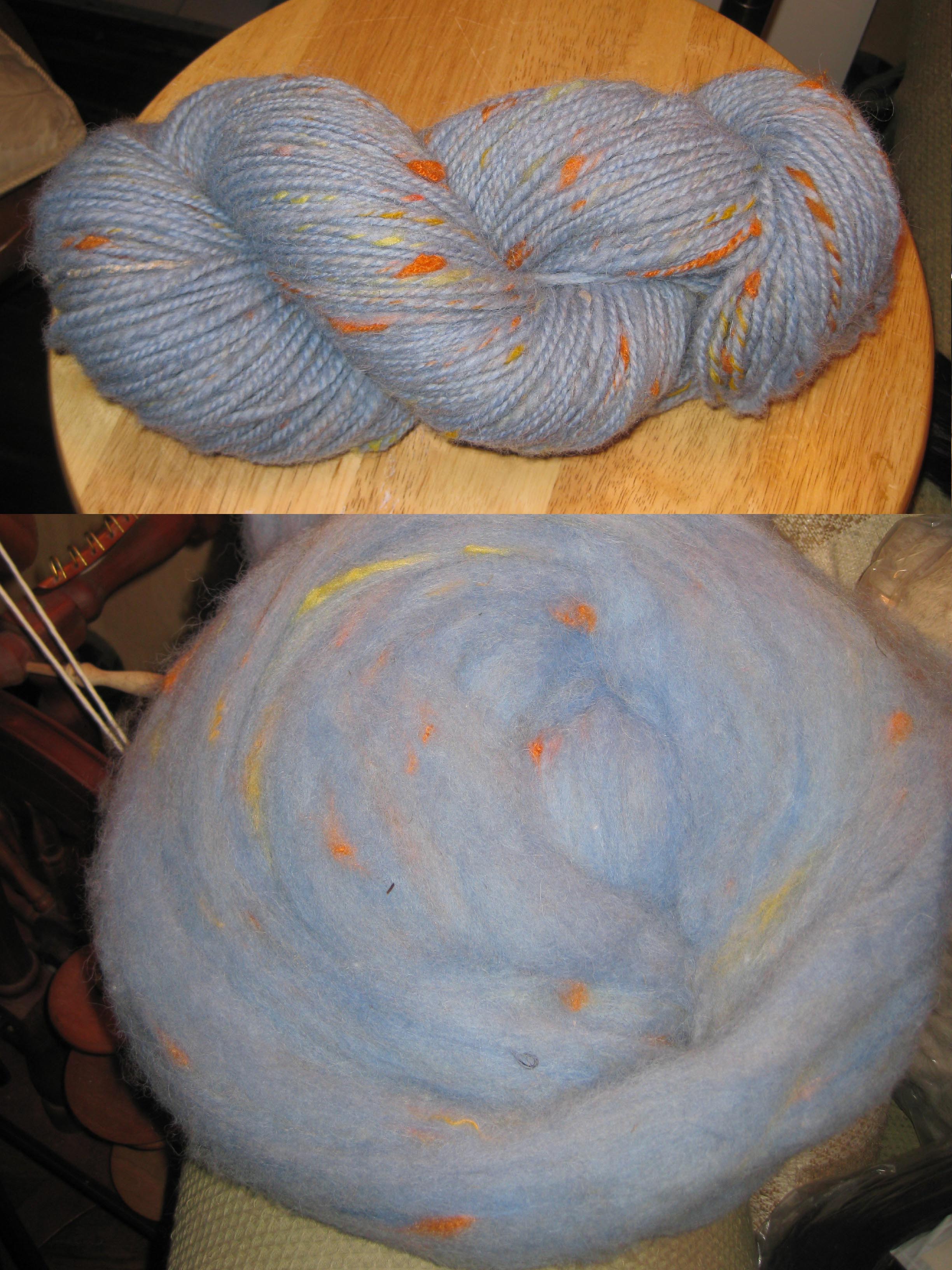
I then chopped up a couple of odd skeins of primarily orange, yellow, and tan and mixed the pieces in with the blue wool. This was then mailed to Spinderella’s to be carded into a batch of custom thrums. See the posting, Happy New Year!, for a look at the resulting roving and a completed skein of yarn.

The skein had over 250 yards on it. I wound it into a cake and set out to make socks for the farmer who had kindly provided the wool. Although the yarn is probably a little heavier, I used Size 2 needles (Size 4 probably would have been more appropriate). But I wanted a heavier, denser fabric. Remember, the poor guy is up in Maine and goes out early in the morning to feed his animals. Heavy wool socks are a plus.

I’m using the Classic Sock pattern from Yankee Knitter Designs. I love this one. It is the one I learned to knit socks on. Cast on 64 stitches and knit about 3 inches of K1, P1 roving, then switch to K3, P1. Because the socks are heavy and the gauge is a little big, I altered the pattern slightly with some decreases along the center back so they won’t be baggy right above the ankle.


I’m pleased with the tweed effect. When you mix a batch of thrums, it takes a while to get the right balance. The first few batches I ever did, I didn’t put enough thrums in. The trick, I’ve found, is to put in enough that it starts to look like too much. They really blend in when carded. This, for me, is a really, really nice balance.


Orange and Purple

January 8, 2010

My friend, Donna, is a professional organizer who branched out into decorating. She was the first one to mention to me that orange and purple made a great combination. “Eeeew,” was my first thought. However, after some persuasion, I realized that the right shades of orange and purple, indeed, would look great together.

When faced with three snow-white Lincoln lamb fleeces, and trying to determine the best 3-color combination for a twist roving, my mind went back to the idea of orange and purple.

I dyed one 2-pound fleece using plain ole’ Rit Purple dye. There was much color left over in the dye bath and a sample showed it to be a lovely shade of lavender. So, a second 2-pound fleece went into the dye pot.

The third fleece got a bit different treatment. One entire little jar of Wilton’s Icing Colors in Orange. And when they say “orange,” they aren’t kidding. A rich, vibrant orange like a daylily. It looked so pretty drying in the sun, it was tempting to just have it carded as is. But, I withstood the temptation and asked Spinderella’s to card the purple and orange twist roving with the orange in the middle. This is the finished roving with a spool of the one strand yarn:


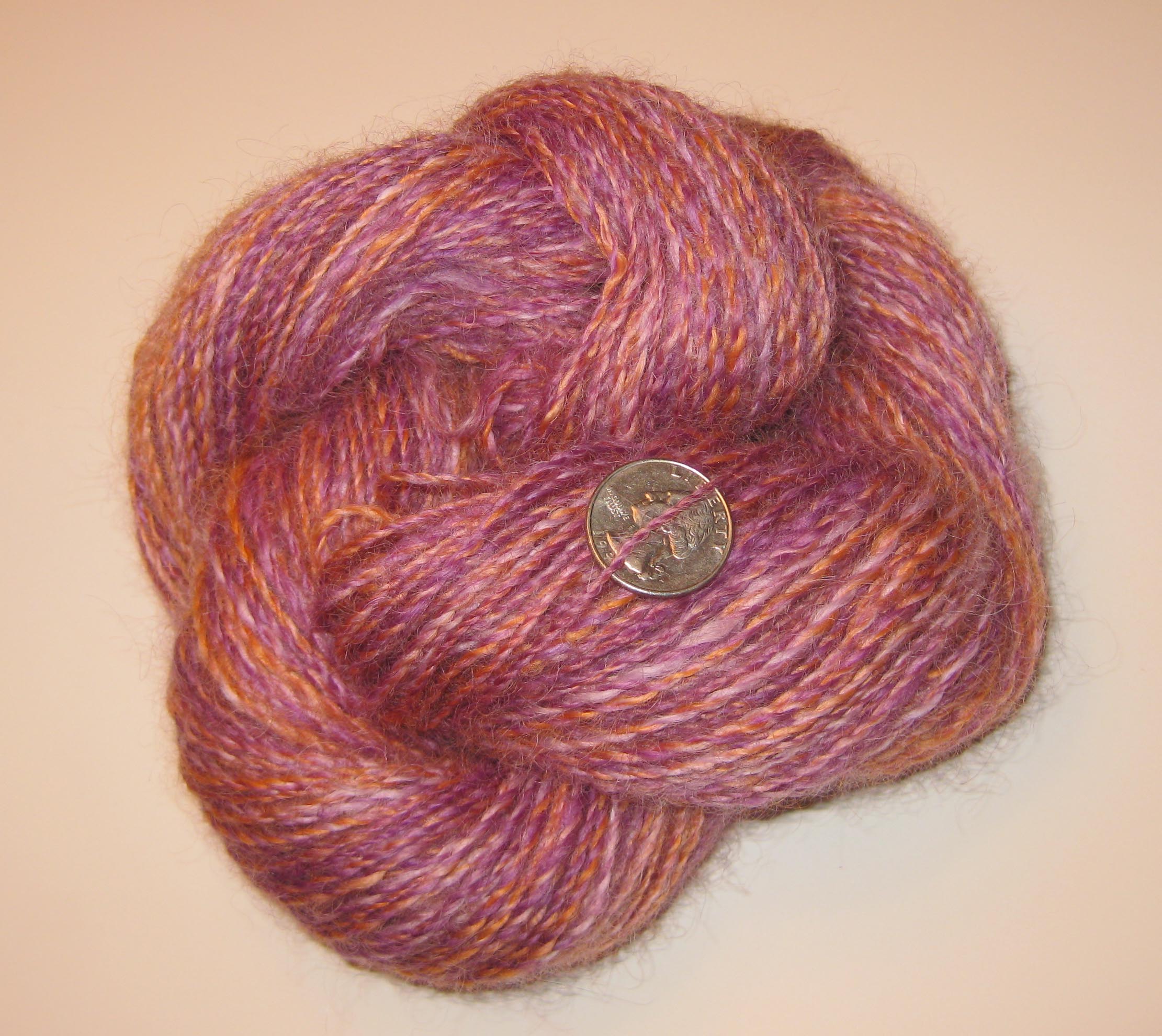
And – ta-da! – here is the completed double-ply strand with the ubiquitous quarter to show the width of the strand:

The spun singles were a trifle wiry, but softened up when plied. Washing started to bring out the halo which longwools tend to produce. This should soften up more as it is knitted and as the halo blooms out.


Happy New Year!

January 4, 2010

The first thing I am learning about blogging is to write everything in a Word document first, and copy and paste into the blog. I write, I upload photos, and then in trying to fix the text wrapping, I invariably lose the post and don’t have time to go back and recreate the whole darn thing. I guess it wouldn’t hurt to click the “Save” button early and often, either!

Well, my lovely week of vacation flew by, but I did make inroads to both new spinning and knitting projects. Spinning was particularly alluring, as I had just received before Christmas a shipment of newly-processed wool from Spinderella’s in Salt Lake City. This was the result of my summer and autumn’s worth of wool washing and dyeing.

The first to get tried out were the blue thrums. The term, “thrums,” technically means loom waste – the stuff left over from tying a weaving project onto the loom. If you don’t happen to have any loom waste lying around, you can take any yarns and cut them into about 3” lengths and mix with wool. This is a good way to get rid of leftovers, odd skeins, and the skeins you inherit from well-meaning friends (you know – “this was in my grandma’s house when she passed away”).

The wool for the blue thrums was a new fleece. I used to buy the clip of a small Shetland herd from a farmer in Maine, but the Shetlands got old and were replaced with white Corriedale crosses. So, no more nice natural colored wool from this avenue, but the white crossbred wool seems to work out nicely. It was dyed with regular old Rit dye and blended with orange, yellow, and red bits. This is what the resulting roving and a skein of the finished yarn looks like:

This will be going into a pair of socks for the Maine farmer who raised the wool.

Next up was the twist roving. This is the first time I branched out with this and am uber happy with the results. I used the three little Border Leicester lamb fleeces from Pegg Thomas at Twin Willows Farms. These were REALLY nice fleeces with no veggie matter in them. I dyed one green, one rose, and one a sort of shrimp pink. You keep the three colors separate when you send them to Spinderella’s, and they get carded side by side so that you get a distinct strip of each color, not all blended together. This is what the resulting roving and a skein of the finished yarn looks like:


The other twist roving was from the three Lincoln Longwool fleeces from Cory Simpson in Montana. If you ever need a good Lincoln fleece, this is the one to go to for soft, lusterous, and clean fleeces. I dyed one purple, one orange, and one lavender. This is what the resulting roving and a single ply on the bobbin look like:

I finished the second bobbin of this and am currently plying it. Haven’t decided yet what to use it for, but I’m sure a project will present itself before long!